The Public Toilet That Has Retired
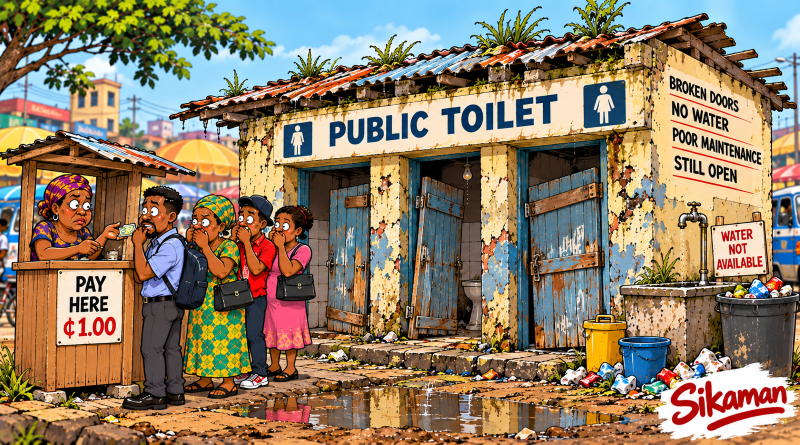
There are public buildings in Sikaman that have reached retirement age without ever receiving retirement benefits.
Some have broken windows. Some have roofs that let rainwater in freely, as though the building has signed a partnership agreement with the weather. Some have doors that no longer close and walls whose paint disappeared several governments ago.
But among all these architectural tragedies, one building deserves special recognition.
The public toilet.
I visited one recently, and I must confess I was impressed.
Not by its cleanliness. Not by its design. Not even by its plumbing.
I was impressed by its determination to remain standing.
The building had the look of somebody who has worked for forty years without annual leave, pension contribution, or even one Christmas hamper. Its walls were tired. Its doors were confused about their responsibilities. The roof looked as though one strong rainstorm could persuade it to pursue a different career.
Yet outside, a sign proudly announced: PUBLIC TOILET.
Public, indeed. The only thing missing was the service.
Eeeii, Sikaman. This was not an ordinary toilet. This was a historical monument. It had witnessed several elections, countless campaign promises, and at least two changes of government. It had survived fuel price increases, the cedi’s many moods, and the arrival of mobile money.
It had not survived maintenance.
The walls were peeling like an old poster left in the sun. The floor had developed patterns no architect would put in a portfolio. A broken tap hung from the wall, apparently waiting for somebody to apologise to it.
And the smell, charley.
The smell had established its own administrative office. It had a desk, a secretary, and a monthly meeting with the flies. It greeted me at the junction, walked me to the door, waited while I paid, came inside with me, and was still standing beside me at the bus stop forty minutes later.
I did not visit the toilet. The toilet adopted me.
Let me tell you about the morning queue, because you cannot understand this building until you have seen it at six o’clock.
At six, Sikaman, the public toilet is the busiest institution in the neighbourhood. Busier than the bank. Busier than the church on harvest Sunday. Busier than the MoMo vendor on salary day.
The queue forms before the caretaker arrives. Men in work clothes holding their bags. Market women with their headpans set down beside them. A schoolboy in uniform, checking the time, calculating whether he will reach assembly before the headmaster reaches the cane. An old man who has been in this queue every morning since the Acheampong era and has stopped expecting anything to change.
Nobody speaks in that queue, charley. It is the quietest gathering in Accra. Every person in it is concentrating on one thing only, and that thing requires their full attention.
And every few minutes, somebody near the back makes a calculation. You can see it on his face. He looks at the length of the line. He looks at his watch. He looks at the open space behind the houses. And then, quietly, with great dignity, he leaves the queue and walks away.
He has not given up, Sikaman. He has simply chosen the express lane.
At the entrance sat the finance department.
The caretaker sits at the door on a plastic chair, Sikaman, and he is the most powerful man in the neighbourhood before nine in the morning. He has a small table. On the table is a bowl for coins, a roll of tissue, and a neat stack of old newspapers torn into quarters.
He did not greet me. He did not need to. I was standing in front of him with one hand on my stomach and the other already in my pocket, and both of us understood exactly who was in charge.
He looked up and asked the question.
“Newspaper or tissue?”
Herh. Do not laugh, Sikaman. Some years ago, a reporter documented the public toilet tariffs in Accra, and they came in classes. Newspaper: thirty pesewas. Tissue: forty pesewas. Economy and business class, for the same seat, in the same building, on the same morning. A man’s dignity could be upgraded for ten pesewas, and somewhere in this Republic a man did the arithmetic and chose the sports pages. He read about the Black Stars with more attention than any sports page has ever received. Some say he still remembers the line-up.
The man at the table was alert, organised, and very familiar with the payment process. There was no confusion whatsoever about the money.
If only the maintenance department worked with the same efficiency.
Because inside, there was a tap.
The tap was physically present, but its contribution to the operation was purely ceremonial. I turned it. Nothing. I turned it again. Still nothing. I looked at it with sympathy. Perhaps it had not been paid. Perhaps it had been on strike for years and was still waiting for management to reply to its letter.
A public toilet without water, charley, is like a restaurant without food, a bank without money, or a church without somebody asking for an offering. You begin to wonder what exactly you have come to do.
Nearby stood a bucket with a cup floating in it. The water in the bucket had seen things. There was no soap. There was soap once. People still speak of it, the way old men speak of the days when bread cost one cedi.
And the door does not close. It leans towards closing, with good intentions, and stops halfway, like a government project at phase two. The bolt was stolen in an earlier administration. So you hold the door shut with one hand and conduct the rest of your business with the other, a skill no school in this country teaches, yet every adult in Accra has somehow passed.
You also learn to hold your breath. Ninety seconds is good. Two minutes is professional. There are men in Nima who could swim for Ghana purely on lung capacity built in public toilets, and the Olympic committee has never once sent a scout.
Now, here is where I stopped laughing.
This is not a small inconvenience for a few unlucky people. Ghana has the highest reliance on shared toilets in the world. Not in Africa, Sikaman. In the world. And when researchers asked public toilet users in two Accra communities how they felt about the facilities, more than eighty percent said they were dissatisfied.
Eighty percent is not a complaint. It is a referendum.
And the other side of the same coin is worse. Ghana has ranked seventh in the world and second in Africa for open defecation. Our people are not doing it because they enjoy it. They are doing it because the alternative is a queue, a coin, and a bucket of water that has seen things.
Let me introduce you to a man those numbers produce. He is forty-three and lives in an Accra compound with no toilet of its own. He told a reporter plainly: on mornings when he has the cedi, he pays. On mornings when he does not, he goes to the open space behind the houses.
Mtcheew. Read that slowly, charley. Whether this man uses a toilet is decided by his wallet, not his manners. The public toilet is not public. It is a shop. And a shop only serves the people who can pay.
And where there is no toilet at all, Sikaman, our people do not give up. They innovate.
In one coastal community near Tema, residents were promised a ten-seater toilet with a modern biodigester. Construction began around 2017. It was abandoned. The half-built walls are still standing, holding nobody.
So the residents developed their own systems. The reports call them “tie and throw” and “take away.”
I will not explain the method in detail, charley. You can imagine a black polythene bag. You can imagine what goes into it. You can imagine where it goes afterwards. And then cholera arrived in that same community, and everybody acted surprised.
Herh. A country that cannot finish a ten-seater toilet in nine years named the alternative “take away,” like a chop bar. Even our tragedies come with a menu.
I sometimes imagine the day our retired toilet was first opened.
Important people arrived in polished vehicles. Somebody arranged chairs. Somebody tested the microphone. A dignitary explained how the facility would improve sanitation, protect public health, and bring dignity to the community.
There were photographs. There were speeches. There may even have been refreshments.
A ribbon was cut, and everybody went home satisfied.
Then the first tap failed. A door broke. The roof began leaking. The paint faded. And the maintenance budget, if it ever existed, entered a period of deep contemplation.
Nobody organised a second ceremony to announce that the facility needed repairs. Nobody invited the dignitaries back to inspect the broken plumbing.
That ceremony would have been interesting. I can hear the MC now:
“Ladies and gentlemen, today we gather to celebrate the retirement of a facility that has served the public faithfully, despite receiving very little assistance from the people responsible for maintaining it.”
There would be applause.
The toilet would leak a little water from the roof in appreciation.
And somebody would promise to investigate.
Awurade. That is the whole disease, my brother. We build for opening day, not for everyday life. A new building gives somebody a ribbon to cut. A repaired pipe has never attracted a photographer. A clean toilet has never once made the evening news. And so the ribbon gets cut and the pipe gets forgotten.
There is an Akan proverb: “Efi a ɛwɔ wo ho no, wo ara na wohohoro.” The dirt that is on you, you yourself must wash it off. Nobody from outside is coming to clean Sikaman’s toilets. This is our own dirt, in our own building, in our own city.
Yes, users must also behave. Nobody should be stealing bolts. But a man who pays every morning has already done his part. The rest belongs to whoever is holding the bowl.
So here is my Kokote Suggestion.
Publish the toilet. Every assembly-owned public toilet should have a board on its door listing who manages it, how much it collected last month, and what was spent on water, cleaning, and repairs. Thirty pesewas multiplied by a thousand visits a day is real money, charley. Somebody is counting it. Let the people paying it count it too.
And here is the strangest finding of all: when users were asked whether they would pay more for a clean toilet, most said yes. The poor man is not refusing to pay. He is already paying. He is simply paying for filth and asking, politely, to pay a little more for soap.
The money was never the problem. The problem is that it goes into the bowl and never comes back out as a working tap.
A city that wants tourists, investors, and the diaspora coming home every December cannot keep its people choosing between a coin and the bush every morning. No Year of Return slogan smells strong enough to cover that.
Onyame mmoa yɛn, Sikaman. God help every person standing in that queue this morning, coin in hand, breath held, hoping the bolt is still there.
The public toilet may be ready for retirement. But the public has not retired from needing it.
Yours, holding my breath since the junction,
Kobina Kokote
Lifetime business-class passenger (tissue, 40 pesewas) · Honorary guest at the retirement ceremony nobody organised · Officially boycotting any facility whose smell arrives before its signboard
P.S. I asked the man at the table why there was no soap. He looked at me with great patience, the way a professor looks at a first-year student, and said: “Charley, the soap is for those who pay for tissue.” I have been thinking about it all week. Somewhere in this Republic there is a third, secret tier that nobody has ever published. We move.
You need a Sikaman Notes account to leave a response. Responses are reviewed before they appear.