The Zebra Crossing Is Not a Zebra Farm
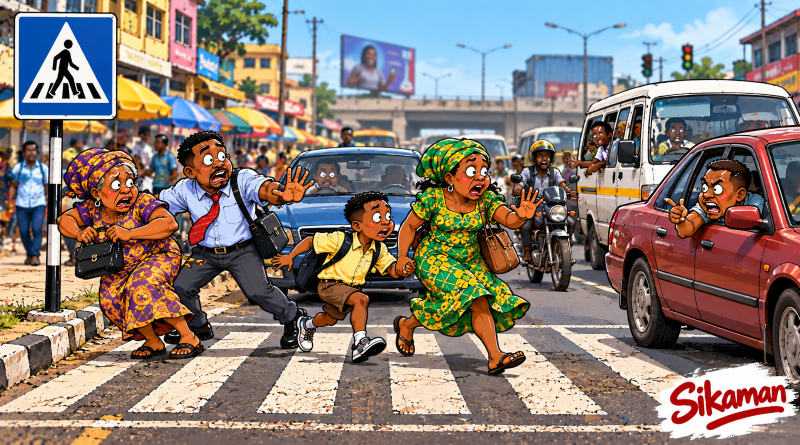
Somebody sits in an office, studies road safety, consults engineers, considers the lives of pedestrians, and finally decides to paint white stripes across the road.
The purpose is simple. When a pedestrian wants to cross, drivers slow down and let the person pass safely.
Beautiful idea.
Unfortunately, the people who need to understand the idea are sometimes the same people who behave as though they have never seen a zebra in their lives.
Come with me to Madina, Sikaman.
There is a man in a shirt and tie standing at the edge of the road with a briefcase. He is standing exactly where the law says he should stand. Under his polished shoes are the white stripes, painted by the state, at public expense, for this precise purpose. He has a bank to reach.
He has been standing there for twenty minutes.
That is not my exaggeration, charley. A bank worker in Madina told a reporter plainly that he waits twenty to thirty minutes at a zebra crossing just to get across and board a car. Half an hour, my brother, standing on the one patch of road that legally belongs to him, waiting for permission to use it.
Eeeii. The man is not trespassing. He is standing on his own property and cannot get in.
Because in Sikaman, the zebra crossing is not always a place to cross the road. Sometimes it is a place to test your faith.
You approach. You look left. You look right. And you prepare yourself for what may be the most important decision of your day.
Should I cross?
Should I wait?
Should I first call my family and tell them I love them?
The driver coming towards you has seen you. You know he has seen you. He knows you know he has seen you.
Yet instead of slowing down, he keeps his speed.
Some even accelerate.
Apparently, the white stripes have offended them personally.
And if you make the mistake of stepping onto the crossing, the horn has plenty to say.
Pooooooon!
You look at him. He looks at you.
His face says: “Are you blind? Can’t you see I am driving?”
Your face says: “Are you driving a vehicle or carrying a government appointment letter? Must everybody wait for you?”
But you are standing in the middle of the road and he is sitting inside two tonnes of metal, so the argument ends before it begins.
You retreat. He drives away in triumph. Another pedestrian has lost the battle against four wheels and one enormous sense of entitlement.
Herh. Perhaps it was an emergency. Perhaps the President was waiting for him. Perhaps the King of England. Or perhaps his wife asked him to buy tomatoes before returning home. Whatever the emergency, somebody else’s life could wait.
Now, Sikaman, let me tell you about the law, because most of you do not know it exists.
Section 20 of our Road Traffic Act says that a driver who parks a vehicle on a pedestrian crossing commits an offence punishable by up to twelve months in prison.
Twelve months, charley. Jail. For parking on the stripes.
Go and stand at any busy junction in Accra this afternoon. Count the vehicles resting comfortably on zebra crossings. Then count the people in prison for it.
The second number, I can give you from here without leaving my chair.
And here is the most honest thing I have read all year. A driver of forty who has worked the Awoshie–Kaneshie stretch for years was asked about zebra crossings. He said, in good faith, that he does not remember zebra crossings being part of road signs at all. He could not name one on his own daily route.
Then he explained his system: “I stop only when I see a red light.”
Aboiii. The whole national philosophy of road safety in eight words. If it is not red, it is not real. The stripes do not glow. The stripes do not count down. The stripes have never once beeped at anybody.
Therefore, in the mind of the Sikaman driver, the stripes are flooring.
They are not instructions. They are not a law. They are not a suggestion from a bored engineer. And they are certainly not the remains of a zebra that wandered onto the road and was painted over by the Urban Roads Department.
This is the great Sikaman paradox.
We paint the crossing because pedestrians need protection. Then pedestrians approach it and discover that the safest thing to do is wait until every vehicle in the country has disappeared.
It is like building a public toilet and placing a guard at the entrance whose only job is to stop people from entering.
The facility exists. The public knows it exists. The authorities can point to it in a press conference and say, “We have provided the facility.”
Whether it performs its function is another matter entirely.
Now let me take you somewhere else, because I have stood on the other kind of zebra crossing and I need you to understand what it did to a Ghanaian man’s mind.
In Amsterdam, the stripes are called a zebrapad. And the rule written into their traffic law is this: the moment a pedestrian sets foot on it, every vehicle must stop.
Not slow down. Stop.
And charley, this is the part that broke my brain. You do not even have to step onto it. If you are merely standing at the kerb looking as though you intend to cross, turning your head towards the road, shifting your weight forward, the driver is already obliged to stop.
Awurade. In Amsterdam, your intention has legal force. You only need to look like a man who is considering it, and the traffic halts for your consideration.
So you walk. Not jog. Walk. You stroll across with your friend in the middle of a conversation about the rent, the weather, and whether his cousin should take that job in Rotterdam, and the conversation does not even pause. A whole line of cars waits for you two to finish making your point.
The first time it happened, my hand went up by itself to do the Ghanaian thank-you wave. The Dutch driver looked at me with mild confusion. In his mind he had done nothing. He had simply not committed a crime, and nobody thanks you for that.
And if he does not stop? Failing to give way at a zebrapad carries a fine running into the hundreds of euros. Where a driver actually endangers or injures somebody, the prosecution can take the licence itself.
Which brings us home, Sikaman, to the saddest thing we do.
On those rare, blessed occasions when an Accra driver does stop, what does the pedestrian do?
He runs. A small, hunched, apologetic jog. And halfway across, without breaking stride, the hand goes up:
“Thank you! Thank you, chale!”
He is thanking the man for obeying the law.
Sit with that. A citizen on a crossing built for him, protected by an Act carrying twelve months in prison, jogs across in gratitude because a stranger in a car decided, out of personal kindness, on that particular Tuesday, to let him have what was already his.
We have taken a right and quietly turned it into a favour. And the moment a thing becomes a favour, it can be refused. The driver who does not stop has broken no law in anybody’s mind. He has simply declined to be generous today. And nobody has ever been arrested for not being generous.
There is an Akan proverb: “Mmara a wɔnhwɛ so no, ɛte sɛ nsuo a ɛwɔ kɛntɛn mu.” A law nobody enforces is like water carried in a basket. You may carry it with great ceremony. You may paint it white and refresh it every two years. But by the time you arrive, your hands are empty.
Now let me stop laughing, because the floor under this joke is made of people.
One hundred and eighty-one pedestrians were killed in Ghana in the first four months of 2026 alone. Four months. Not injured. Killed. The Road Safety Authority’s own regional director called it a public safety emergency, and he was being polite.
And here is the fact that should end the argument for good. The zebra crossing works. It is the safest place on the whole road to cross. Research in this country found that a pedestrian is roughly four times more likely to die crossing fifty metres away from a zebra crossing than on one, and nearly seventeen times more likely to die crossing somewhere else entirely.
Mtcheew. The stripes are not useless. They are the most protective thing on the road. And almost all our pedestrian collisions happen away from them, because driver and pedestrian have agreed together that the safest place to stand is the one place nobody takes seriously.
We built the lifeboat. We painted it white. And then we all agreed to swim.
Yes, pedestrians have their sins too. Some cross wherever they please, staring at their phones and trusting the ancestors to manage traffic. But a careless pedestrian has never once given a driver permission to run him down.
So here is my Kokote Suggestion, and it is cheap enough to begin this month.
Pick one crossing. One. Madina, Kaneshie, or Circle. Put two MTTD officers there for thirty days. Not to collect anything by the roadside, charley. To issue proper tickets, with numbers, to every driver who does not stop.
Because the man from Awoshie is not wicked. He genuinely does not know the stripes are law. Nobody has ever told him in a way that cost him anything. The Dutchman does not stop because his heart is softer than ours. He stops because it costs him hundreds of euros not to. Take away the fine and he would drive like us within one rainy season.
It was never about character. It has always been about consequence.
One junction. Thirty days. Then let us find out whether the painting is decoration or law.
Remember too, every driver eventually becomes a pedestrian. One day you will park in a lot and walk across a road yourself, and you will discover that the person waiting at the crossing is not an obstacle to your journey. He is a human being trying to complete his own.
Onyame nhyira wo, Sikaman. God bless every pedestrian still standing at the edge of the road, waiting politely for permission to use something that was always theirs.
Yours, still jogging and still waving,
Kobina Kokote
Lifetime thanker of drivers who obeyed the law · Honorary graduate in Advanced Pedestrian Studies (three consecutive survivals) · Officially boycotting any right that must be requested with a raised hand
P.S. To the driver who saw me at the crossing this morning, sounded his horn, and accelerated: my brother, please keep that horn in good condition. You may need it to announce your arrival at the Pearly Gates, assuming you get there before somebody else crosses your path. And when you arrive, look down at your feet. I am told the road leading in is painted with white stripes, and up there, they actually stop. We move.
You need a Sikaman Notes account to leave a response. Responses are reviewed before they appear.