
Sikaman Notes: The Price Is Whatever He Feels Like Today
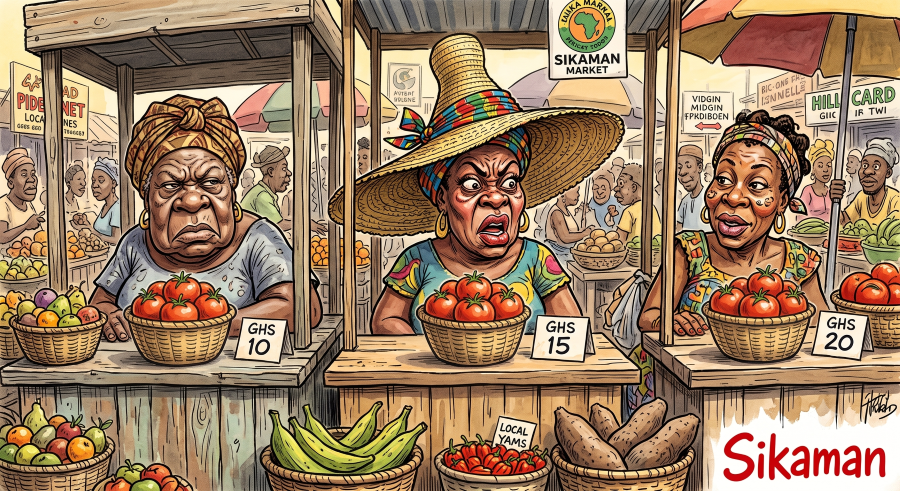
Ask three sellers in the same market the price of the same tomato, Sikaman, and you will receive three different answers, delivered with three completely different levels of confidence, none of which relate to the tomato itself.
The first woman will say twenty cedis. The second, standing four stalls away, selling the exact same tomato from the exact same truck that arrived that morning, will say thirty. And the third, Sikaman — the third will look at your shoes, your bag, your accent, the way you greeted her, and calculate a number that has nothing to do with tomatoes at all. Forty-five cedis, she will say, with the calm authority of a woman reading a price that only she can see, written somewhere on your forehead.
Eeeii. Welcome to the national pricing system — a system with no system, charley, where the only fixed thing about the fixed price is that it is never actually fixed.
Let me be plain about what this looks like in practice, because every Ghanaian has lived it and every foreigner who stays long enough eventually learns to fear it. You walk into a shop. You ask the price of an item. The seller looks at you — not the item, you — and begins the small, silent calculation that determines your fate. Are you a regular? Small discount. Are you a stranger? Standard markup. Are you clearly “abrokyire” — recently returned, recently arrived, dressed slightly too well for a Tuesday, speaking with the particular confidence of someone who converts prices into dollars in their head before agreeing? Charley, the price just found its ceiling and kept climbing.
And this is not one rogue trader having a difficult day, Sikaman. This is the system. There is no printed price tag on half the goods sold in this country that means anything once a human being enters the equation. The price is a conversation, not a fact. It moves depending on your clothes, your car, your company, your mood, and the seller’s mood, and whether it rained that morning, and whether your Twi is fluent enough to signal that you cannot be easily separated from your money. We have built an entire economy on vibes, charley, and called it commerce.
Now — here is the part that should genuinely trouble us, and it is not funny at all. While we are haggling over tomatoes with three different prices from three different women at the same market, the tomato itself, Sikaman, is quietly one of the most expensive in the region. Ghana — a country with good soil, real farmers, real seasons for growing — routinely sells tomatoes in Accra at a price that exceeds what the same tomato costs in countries that have to ship it in from thousands of miles away. Read that again, charley. A country that grows its own tomatoes is charging more for them than countries that do not grow tomatoes at all. This is not a joke about market women. This is a genuine, documented policy failure — nearly two billion dollars lost every year to bad roads, no cold storage, and a supply chain that lets the crop rot before it reaches the city, so that what finally arrives is scarce, bruised, and priced like a luxury.
Awurade. We are importing over seven thousand metric tonnes of tomatoes a year, Sikaman, in a country whose own farmers are watching their harvest spoil by the roadside because the truck did not come. The farmer did not fail us. The system between his farm and your market failed him first, and you are paying for that failure at the till, three different amounts, depending on which stall you happened to stop at.
And the rent, charley — let us not even start on the rent. Landlords in this city have taken to pricing apartments in dollars, in a country whose own currency is the cedi, hedging their own fear of inflation onto tenants who are paid in cedis and have no dollars to hedge with. The result, Sikaman, is genuinely strange when you place it beside our neighbours: Lagos — bigger, louder, more commercially intense than Accra by every measure — regularly offers comparable housing at a lower dollar-equivalent price than what Accra now demands. A smaller city, charging its own residents more aggressively than a much larger one. That is not simply “expensive.” That is a structural oddity that deserves an honest answer, and nobody in charge is offering one.
And then, Sikaman — and then — there is the Year of Return effect, the one nobody wants to say plainly because it sounds ungrateful, but here it is anyway: since the diaspora came home in numbers, the prices in certain neighbourhoods have quietly rearranged themselves around the visitor’s wallet rather than the resident’s. A pharmacist in Osu, a man with three daughters and an honest job, told a journalist he can no longer afford to take his own family to eat in the neighbourhood he lives in, because the restaurants there have started “charging according to the pockets of the foreigners.” His monthly pay would not cover one family dinner at the very restaurants sitting on his own street. We built the welcome mat so beautifully, Sikaman, that we forgot to leave room on it for the people who already lived in the house.
There is an Akan proverb: “Sɛ wo yɔnko yɛ wo yiye a, wo nso yɛ no yiye.” — If your neighbour is doing well for you, you should also do well by them. We have inverted this completely, charley. The visitor arrives, is treated generously — even overcharged generously — while the neighbour, the actual resident, the man who has lived on that street his whole life, finds the same generosity has priced him clean out of his own block.
Let me also say, in fairness, what the government has actually gotten right, because Kokote does not pretend improvement did not happen. Inflation fell for thirteen straight months. The cedi appreciated more than any other currency in Sub-Saharan Africa last year. Reserves are healthier than they have been in years. These are real, measurable achievements, Sikaman, and they deserve to be said plainly, not buried under complaint. But here is the maddening part: none of that macroeconomic good news has reached the tomato seller’s three different prices, or the landlord’s dollar invoice, or the pharmacist’s restaurant bill in Osu. The numbers on the Bank of Ghana’s dashboard are healing. The numbers at the market stall have not received the memo.
So here is my Kokote Suggestion, and today it has two addresses. To the trader: a fixed, printed price, honoured for every customer regardless of shoes, accent, or car, is not weakness, charley. It is trust, and trust is what keeps a customer coming back rather than negotiating like it’s a hostage situation every single time. And to whoever holds the pen on policy: fix the road before you fix the price. Build the cold storage before you build another slogan. Because a fixed-price law, charley, means nothing to a tomato that rotted three villages before it ever reached a shelf to be priced at all.
Onyame mmoa yɛn, Sikaman. God help us — the only country where the tomato has three prices, the rent has a foreign currency, and the welcome mat is so generous that the people who live in the house can no longer afford to sit in their own parlour.
Yours, asking the fourth seller just in case,
Kobina Kokote
Lifetime negotiator of prices that should not need negotiating · Honorary economist of the tomato-to-Accra supply chain · Officially boycotting any price that changes depending on my shoes
P.S. — To the pharmacist in Osu: chale, I am sorry your own street forgot your name. The Year of Return was supposed to bring the family home, not price the family out of the kitchen. We move.
You need a Sikaman Notes account to leave a response. Responses are reviewed before they appear.