
Sikaman Notes: Everybody’s Ground
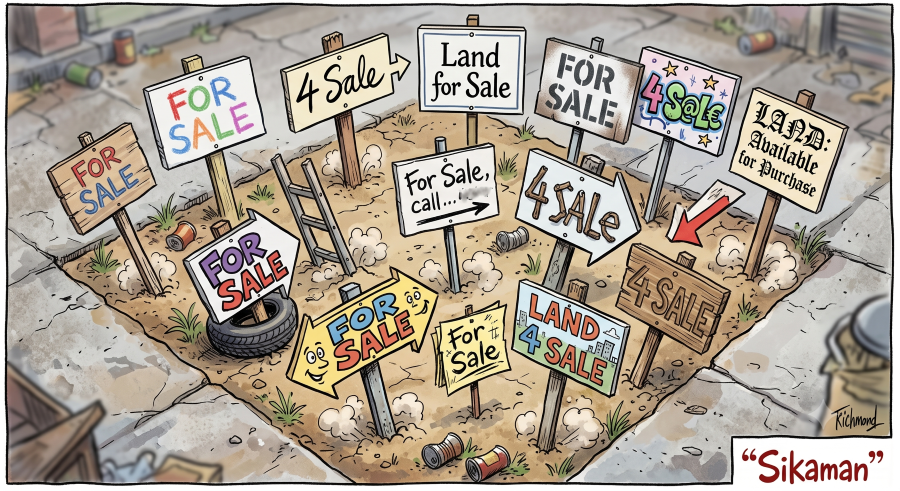
In 2014, a case reached the Supreme Court involving a fifty-acre plot of land somewhere in this Republic.
The court opened the file. The court read the documents. And the court — the highest court in the land, Sikaman, the court that has seen everything this country can produce — expressed “shock” at what it found inside.
Thirteen different sellers had been registered for the same piece of ground. Thirteen, charley. Not two brothers arguing over a family house. Not three cousins disputing an inheritance. Thirteen separate human beings, across thirty years, each one selling the same fifty acres to a different buyer, each one presenting documents, each one collecting an envelope, each one shaking hands and saying “the land is yours” — and walking away to wait for the next customer.
Eeeii. Fifty acres. Thirteen sellers. Thirteen buyers. Twenty-six people convinced they are right, and one piece of ground that belongs to all of them and none of them at the same time. If the land could speak, charley, it would need a lawyer for each of its owners. And a therapist for itself.
Welcome to the Republic of Everybody Owns This Land.
Let me describe the system, Sikaman, because calling it a system is the most generous thing I shall say about it today. Eighty percent of all land in Ghana — eighty percent, charley — sits under what the law calls customary ownership. Chiefs, stools, skins, family heads. The remaining twenty percent belongs to the government. And these two systems — the customary and the statutory — do not talk to each other, do not agree with each other, and regularly issue competing ownership documents for the exact same piece of ground, the way two taxi drivers issue competing prices for the same journey, except in this case the journey costs GH¢50,000 in legal fees and lasts a decade.
And the proof of ownership, my brother? In most of this country, the proof is not a title deed stored in a digital database and verified by a central authority in thirty seconds. The proof is a handshake. An oral agreement. A handwritten allocation paper, signed by a chief whose authority may or may not extend to the specific parcel he just sold, witnessed by an elder who may or may not have been present, stamped by a secretary who may or may not exist. “The family has agreed to sell” — the most dangerous sentence in West African property law — because which family? Which agreement? The family is thirty-seven people, and thirty-six of them are currently in court disputing what the thirty-seventh agreed to while they were at a funeral.
Herh. And the registration, Sikaman — Awurade, the registration. To officially register a piece of land you have already bought and already paid for takes, on average, over thirty-six months. Three whole years. In that three-year gap, the same land can be sold again — to someone else, by someone else, with someone else’s handshake and someone else’s allocation paper. By the time your registration is complete, charley, you may be the fourth owner of a plot that only exists once. You are in a queue, Sikaman, and the thing you are queuing for is being sold to the people behind you while you wait.
And then there are the land guards. The men hired to “protect” your land while the registration crawls through the system. Armed, sometimes. Intimidating, always. Standing on your half-finished plot with the specific energy of men who have been told that this ground belongs to somebody, and that somebody is paying them, and anyone who disagrees should consider whether disagreeing is worth the conversation that will follow.
The land guards have been criminalised under the Land Act of 2020. They are still there, charley. The law said stop. They did not hear the law. And the funniest part — the part that should be studied in universities of the absurd — is that some land guards work for both sides of the same dispute. A man hired to protect Plot A from the buyers of Plot B, who is also, quietly, being paid by the buyers of Plot B to protect Plot B from the buyers of Plot A. The man is fighting himself for double pay, Sikaman, and both clients believe they are getting value for money.
Now — let me take you to the forest, charley, because the forest is where this story stops being merely expensive and starts being genuinely dangerous.
Every forest reserve in this Republic was gazetted for a reason — to protect the water, the soil, the air, the animals, the things that keep a country alive long after the chief who sold the land has spent the money. And yet, across this country, forest reserves are being sold as residential land. The trees are cut. The ground is parcelled. A buyer arrives, pays, builds — and discovers, three rainy seasons later, that his “prime residential plot” is actually a protected wetland whose only previous residents were frogs and floodwater. The land remembered what it was, charley. Even if the seller forgot to mention it.
And the capital’s last surviving urban forest — eeeii, Sikaman — 889 acres of green in a city choking on concrete, sandwiched between a school and a highway — this forest has been through more ownership drama in four years than most families produce in four generations.
In May 2022, an Executive Instrument was signed that declassified 361 acres of the forest. Three hundred and sixty-one acres, charley. The government said it was returning “peripheral land” to the original family who sold it to the British in the 1920s for £4,000. Social media caught fire. The Minister said “the forest has NOT been sold.” The opposition said it was dangerous. Environmental groups said it was irreversible.
And then, the same week — the same week, Sikaman, you cannot write this — a dead man’s will leaked online.
Aboiii. Not just any dead man, charley. This dead man had been the Director of the Forestry Commission. Not a friend of the Commission. Not an adviser. Not a man who once visited a forest on a school trip. The Director. The man whose salary was paid by the Republic to protect Ghana’s forests. The guardian. The gatekeeper. The man with the key.
And in his will — written in his own hand, filed with his own lawyers, intended for his own family — he bequeathed:
Over five acres of that same urban forest — hidden under a shell company with a name that sounded like something invented during a board game — divided among five relatives, one acre each.
Nearly one more acre of the same forest — hidden under a second shell company — given to three nephews.
And over five acres of an internationally protected wetland — a Ramsar site, charley, protected not just by Ghana but by an international treaty signed by countries on four continents — bequeathed to his sisters and their children.
Herh, Sikaman. HERH. The Director of the Forestry Commission — the man whose entire job was to stop people from taking forest land — was himself taking forest land, hiding it under shell companies with names that sound like they were invented during a game of Ludo, and distributing it to his family in a document that only became public because he died and the will leaked. The security guard was the thief. The goalkeeper was scoring own goals. The man hired to keep the foxes out of the henhouse was, himself, the fox — and he had been filing paperwork about it the whole time.
The dead man told on himself, charley. From the grave. In his own handwriting. With acreage measurements and company names. The dead man was more transparent about his affairs than any living official has managed to be about theirs. At least he wrote it down.
And the Lands Commission and the Forestry Commission — the two agencies that are supposed to track who owns what — said they had no record of the Director owning any land in either location. Which means either the records are wrong, or the Director was claiming land that was never officially his, or — and this is the option that makes Sikaman’s head hurt the most — the system that is supposed to track ownership in this country simply did not notice that its own Director was helping himself to forest and wetland while drawing a salary to protect it.
And just this month — July 2026 — the Cabinet finally revoked the Executive Instrument entirely, restoring the forest to full protected status. Four years, Sikaman. Four years to undo a document that took one signature to create. The forest went through more ownership changes than a trotro goes through traffic.
Now — before you think this is only a Ghanaian disease, let me introduce you to our cousins in Nigeria, because Nigeria has taken this chaos and turned it into an entire economy.
In Lagos, charley, there is a system called Omo Onile — meaning “children of the landowner” in Yoruba. These are people who claim ancestral ownership of land and have built an entire industry around never, ever, letting go.
You buy land in Lagos. Properly. With government documents. You begin building. The Omo Onile appear. “This was our grandfather’s land. You owe us.” You pay them. You lay the foundation. They come back. “Foundation fee.” You start roofing. They come back. “Roofing fee.” You finish the house. They come back. “Completion fee.” Your son gets married inside the house — charley, inside your own completed, fully paid-for house — and the Omo Onile return one final time: “Celebration dues.”
Celebration dues, Sikaman. Your happiness has a surcharge. The invoice arrives before the cake is cut. One man in Lagos refused to pay the wedding celebration fee. The Omo Onile destroyed the tents. They tore down the decorations. The wedding that was supposed to celebrate love became a demonstration of who really owns the ground the love is standing on.
Mtcheew. And it gets worse. Over seventy percent of landowners in Lagos have been extorted by Omo Onile at least once. They sell the same plot to multiple buyers — then sit back and watch the buyers fight each other while the Omo Onile collect from all of them. And late last year, two different factions of Omo Onile — both claiming to own the same estate — fought each other with cutlasses, locking the actual residents inside the estate gate. The people who live there — the families, the children, the ones who paid for the houses — were trapped between two groups of men fighting over who has the right to extort them.
And under Nigerian law — the Land Use Act of 1978 — ALL land is technically vested in the state Governor. Nobody can sell without government authorization. The law is in the capital. The Omo Onile are in Lagos. The two have never been properly introduced.
There is an Akan proverb: “Asase yɛ duru — na enye obiara dea.” — The earth is heavy — and it does not belong to anyone. The elders said this, charley, long before the first land guard was hired, long before the first allocation paper was handwritten, long before a Director put a forest in his will under a company that sounded like a board game. The earth is heavy. It carries all of us, and it belongs to none of us. We are guests on it — temporary, mortal guests — and the fights we are having over its surface will look very small from underneath it, where all of us eventually end up, regardless of how many acres we managed to register before we arrived.
So here is my Kokote Suggestion, and today it comes in two parts.
To the system: finish the digital registration. The project to reduce land registration from thirty-six months to thirty working days — finish it, charley. Not in a press release. Not in a pilot phase that has been piloting for years. Finish it. Because every month the old system survives is another month a fifty-acre plot acquires its fourteenth seller.
To every Ghanaian planning to buy land: check everything three times. Search the Lands Commission. Hire a lawyer. Visit the land physically. Ask the neighbours — the neighbours, charley, know more about who owns what than any office in Accra. And when the chief says “the family has agreed” — ask to meet the family. All of them. Not the three who came to the signing. The other thirty-four who will arrive at your foundation-laying with a different document and a different story.
Onyame mmoa yɛn, Sikaman. God help us — a country where the ground has more owners than the building on top of it has rooms, and the man hired to guard the forest put the forest in his will.
Yours, checking the documents a fourth time,
Kobina Kokote
Lifetime victim of the thirty-six-month queue · Honorary investigator of shell companies with board-game names · Officially boycotting any land transaction that begins with the sentence “the family has agreed”
P.S. — To the Director, wherever you are resting: my brother, you wrote it down. In your own hand. With company names and acreage. You told on yourself from the grave more honestly than any audit has ever told on the living. The shell companies sounded like hiding places with registration numbers. Next time — though, charley, there will not be a next time — at least pick names that do not sound like they were invented during a game of Ludo. We move.
You need a Sikaman Notes account to leave a response. Responses are reviewed before they appear.