Sikaman Notes: The Woman With the World on Her Head
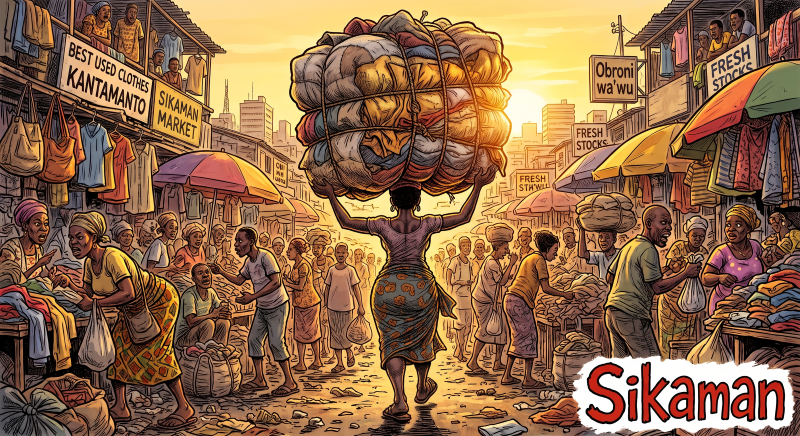
She is somewhere in Accra right now, charley. Right now, as you read this. At Kantamanto, or Makola, or Agbogbloshie, or Kejetia in Kumasi. She arrived before sunrise. She is wearing a cloth on her head — not for decoration, not for fashion — as armour, because what she is about to place on that cloth weighs more than most men would attempt with their arms, let alone their heads. A bale of obroni waawu, secondhand clothing shipped from Europe in a 120-pound bundle, pressed tight, tied with wire. She bends. She lifts. She straightens. And she walks.
This is the kayayo. And Sikaman — we do not see her.
Not really. We see the load. We see the inconvenience when she moves slowly through the market and we are in a hurry. We see her at the junction, waiting for someone to hire her, and we look past her the way you look past a gutter — it is there, you know it is there, you are grateful it does the work it does, and you do not think about it again until it overflows.
Let me tell you who she is, my brother, because the newspaper does not often bother.
She is from the north — from Walewale, from Kpilo, from Tamale, from Bolgatanga, from small communities where the dry season is long and the farm season is short and a girl’s options, when the family runs out of money for school fees, are two: marry early, or come south to carry. She chose to carry, charley. She chose the heavier option because it was freer. One girl told a journalist something that should be printed on every government document about the north-south divide in this country: “At home, I had to work too much. Here I’m free. I don’t work for anybody. After the market, I can sleep.” Free, my brother — she called carrying 120 pounds on her head freedom — because the alternative, back home, was somebody else’s kitchen and somebody else’s children and somebody else’s decisions about her life from the day she was born.
She came to Accra with a number in her head. A small, specific number — the amount she needs for school fees, or for a uniform, or for a small trading capital, or simply to prove to herself that she can earn and keep and spend without asking permission from a man. She arrived knowing nobody. She found the market. She found other kayayei — singular: kaya yoo — who showed her how the system works, where to wait, how to negotiate a fee for each load, where to sleep. Where to sleep, Sikaman. Because she sleeps in Old Fadama, the slum on the edge of the Korle Lagoon. She shares a room with ten, twelve, sometimes twenty other women. Side by side on the floor. To use a toilet, she walks down the street and pays. Every morning, she walks past fires where people burn e-waste — the smoke thick with melting plastic — to get to the market where the day begins again.
And in the market, charley, what does she earn? A few cedis per load. Sometimes five. Sometimes three. On a good day, at the end of twelve hours of walking, bending, lifting, straightening, waiting — twelve hours, my brother, when your whole body is paining you — she may have thirty cedis. She sends some home. She eats the rest. Some days the market is slow and there are more kayayei than loads and she earns almost nothing. On those days she eats less.
And we walk past her at Kantamanto arguing about the price of second-hand trousers.
Ao, Sikaman. Ao.
There are people in this country, my brother, who carry 120 pounds on their heads for twelve hours so that other people can buy a GH¢20 blouse, complain it is too expensive, bargain it down to GH¢15, and post it on Instagram. The kayayo who carried the bale that contained that blouse across the market will never know the blouse exists. She will never know the name of the person who bought it. She will never know that her labour, her back, her neck, her twelve hours — that all of it was part of the supply chain of the obroni waawu global fashion industry, which ships its unwanted excess to Ghana because it is cheaper to dump it here than to recycle it at home. The world’s waste travels on her head, Sikaman, so that the world can feel better about its wardrobe.
And when she is sick — ao, when she is sick — she goes to the hospital and the health worker looks at her and asks, in front of other people: “Why are we wasting money on these girls?”
Herh. HERH. A health worker. A person whose entire calling is the care of the suffering. Looking at a woman who carries the weight of somebody else’s excess on her spine every day, who walks past burning toxic waste to get to a market that pays her almost nothing, who sleeps on a floor with twenty other women and pays to use a toilet — and asking why we are wasting money on her.
There is an Akan proverb: “Onipa na ohia onipa.” — It is a human being that needs another human being. That health worker forgot, charley, that every human being — every single one — sits somewhere on a chain of invisible labour that they did not build and cannot see. The food on the hospital cafeteria table arrived because somebody carried it. The cloth on the market stall arrived because somebody bore it. The city runs because she runs it. And we have decided, somehow, that the people who run the city deserve the least of what the city produces.
But Sikaman — and this is the part I hold on to, because Kokote cannot end without the light — she does not always stay. She is not always defined by the load. Azumi Mahami carried loads for twelve years at Tema Station, Makola, Tudu, Kantamanto. She sent money home. She paid for her mother and seven siblings in Walewale. She got tired of carrying. She started selling rice. She opened a chop bar with six employees. She built her mother a house. Feeli feeli, charley — you have to see it to believe it. A woman who slept on the streets of Tema Station now has six people on her payroll. The kayayo who was invisible is now the employer that other people are grateful for.
Azumi is not an exception, Sikaman. She is what happens when a woman with that kind of strength and that kind of will is given one small opening — one moment where the market turns, one piece of luck, one person who did not look at her and ask why they were wasting resources. Imagine, my brother, what would happen if Sikaman gave her not one small opening but a door. A real one, with a handle she could reach.
There are organisations trying. The Unspoken Voices Project, launched this year, calls the kayayei crisis “a silent emergency hiding in plain sight.” Scholarship programmes, apprenticeships, health registration — small things being done by small NGOs with not enough money. But the government that can find billions for a gate at the airport, charley — the same government that can launch a twelve-week awareness campaign for a twelve-week rainy season — that government has no sustained programme for the women who carry its markets on their heads. Not one. The kayayo is essential and invisible in exactly the same proportion, and that proportion has not changed since before independence.
So here is my Kokote Suggestion. See her. That is the first thing, and it is not small. The next time you are in the market and she moves slowly because 120 pounds is moving slowly, wait. One minute of your time, charley. Give her the path. When you agree a fee for her to carry your goods, pay her fairly. Do not bargain her labour the way you bargain a cloth — her back is not a starting price. And when you have a position in government, in health, in education — remember that she is not an inconvenience. She is not a development problem to be solved in a policy document. She is a Ghanaian woman who got up before you this morning and has been working since before you finished your breakfast, and she deserves, at the very minimum, not to be asked why she is worth the money.
Onyame nhyira wo, kaya yoo. God bless you — every woman who bends and lifts and straightens and walks and bends again, every day, in every market in Sikaman, carrying the weight of a city that has forgotten your name.
Yours from the market floor, looking up,
Kobina Kokote
Lifetime witness of invisible labour · Honorary customer who pays the full fee · Officially boycotting any health worker who asks why a working woman deserves care
P.S. — To Azumi, in her chop bar in Accra: my sister, the jollof is famous now. I have heard about it from three people who do not know each other. That is not word-of-mouth. That is a legacy. Medaase paaa. We move.
You need a Sikaman Notes account to leave a response. Responses are reviewed before they appear.