
Sikaman Notes: The Cows Are Living Better Than Us — A Tour of Sikaman’s Ghost Houses
My dear Kojo,
How are you keeping, my brother? How is work? I hope Oga at the warehouse is still finding good things to say about you, and not the other kind of things that end with a phone call to the family.
And Kojo — before you continue reading — I must ask the question the whole family has appointed me to ask, because nobody else was brave enough and I, unfortunately, was the last man standing at the meeting. Have you sent the money?
You know the one, Kojo. The “small small” one. The one Aunty Comfort mentioned at Christmas, then mentioned again at Easter, then mentioned a third time in a WhatsApp voice note that was fourteen minutes long and somehow still ended with “anyway, no pressure, just when you can.” No pressure, Kojo. No pressure. The same way there is no pressure when the landlord clears his throat on the first of the month.
I am not asking for myself, my brother — Nyame na onim, I have my own small requests waiting in the queue behind Aunty Comfort’s — I am only the messenger, and messengers in this family are not permitted to return home until the message has been delivered and a response has been extracted. So please, Kojo. Send the money. Or send me a very good excuse, written clearly, that I can read aloud at the next family meeting without being personally blamed for your silence.
Now — now that the family business is out of the way — let me tell you something else, Kojo, something that has nothing to do with money you owe and everything to do with money that has already disappeared. Because while Aunty Comfort is waiting for her small small, I want to tell you about three hundred acres of land outside Accra where a much, much bigger small small went missing — enough of it to have built her a whole house, and four thousand others besides.
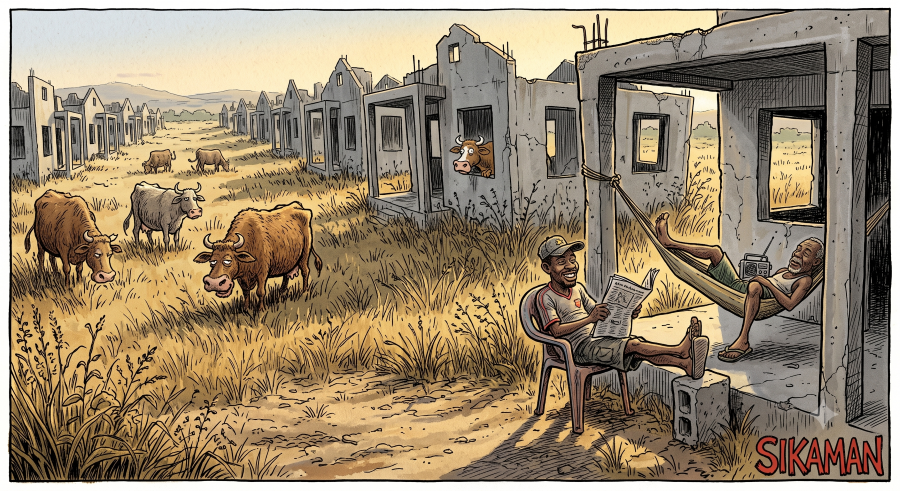
Kojo, I want to tell you about a housing estate where the only residents are cows.
Not people, my brother. Cows. Real ones, with real horns, grazing quietly between rows of houses that were built — paid for, Kojo, with real money — for human beings who are, at this very moment, sleeping four to a room somewhere in Accra because they cannot find anywhere to live.
Let me tell you the story properly, because you deserve to hear it slowly, the way I heard it.
Years ago, somebody had a good idea. A truly good idea, charley. Build five thousand homes on that land. Small, honest homes, for the ordinary worker — the nurse, the teacher, the driver — people who work every day but can never save enough to own the roof over their own head. Borrow the money properly, get Parliament to approve it, hire a contractor, and build.
Eeeii, Kojo. Five thousand homes. Can you imagine? Five thousand families who would never again have to pay two years’ rent in advance to a landlord who changes his mind every December.
But my brother, this is Sikaman, and Sikaman does not finish what Sikaman starts.
The money came — nearly two hundred million dollars of it, borrowed in the nation’s name, to be repaid by the nation’s children. And when the building stopped, when the argument started, when one government pointed at the next and the next pointed back — do you know how many of the five thousand homes were actually finished? Somewhere between six hundred and fifteen hundred, Kojo. Depending on who you ask, and who is currently trying not to go to prison over the answer.
Herh. Less than a third of the promise. Nearly two hundred million dollars spent, and the houses that were built — the ones standing there right now, with real walls and real roofs — are not fit for anybody to live in. Not habitable, the investigators said. Two hundred million dollars, and the finished product cannot be trusted to keep the rain off a family’s head.
So what happened to those houses, Kojo? What happens to five hundred empty homes on three hundred acres of open land, with nobody watching, for years and years?
The cows moved in.
I am not joking with you, my brother. Cattle now graze freely between the buildings. The grass has grown up around foundations meant for kitchens. Doors that were never hung swing open to nothing. A whole small town, built and half-abandoned, has quietly become the finest pasture in the region — better maintained, ironically, by the cows eating the grass than by any government department paid to maintain it.
One Member of Parliament, standing in front of those empty houses, looked at the whole sad picture and said something so honest it should be written on a wall somewhere: people are crying looking for a place to sleep, and we have wasted this property. He was so angry, Kojo, that he offered to personally let ordinary Ghanaians simply move in and occupy the empty houses — consequences be damned. Just come and live in them, he said. This is sad.
Ao, Kojo. When a man in a suit, standing in front of a government scandal, is reduced to saying “just come and squat in it,” you understand the size of the shame we are dealing with.
And this is not the only ghost house in the Republic, my brother. Not far from there, in another region, there is a youth centre that was supposed to seat ten thousand people — a proper stadium, a running track, courts for every sport a young Sikaman could dream of playing. Started with a completion date. That completion date came. Went. Came again the following year. Went again. Today, it stands half-built, silent, a monument to a ribbon that was never cut.
There is an Akan proverb: “Deɛ wanhwɛ n’akyi no, ɔbɛtɔ.” — He who does not look behind him shall fall. We built these houses looking only forward — toward the next election, the next headline, the next sod-cutting ceremony. Nobody looked behind to check whether the last promise had actually been kept before making the next one. And so we fall, Kojo, again and again, into the same open grave of an abandoned foundation.
Mtcheew. Let us do the maths together, my brother, because you should know what silence costs. Nearly two hundred million dollars for a housing project that now feeds cattle. Nearly two hundred million more, some say, simply to finish what was already half-built and left to rot — money that would not have been needed at all if the first two hundred million had been spent the way it was meant to be spent. That is not one bad decision, Kojo. That is four hundred million dollars of the same bad decision, told twice.
And the cruel joke sitting underneath all of it, my brother — the joke that is not really a joke at all — is that this country has a housing shortage of nearly two million homes. Families are queuing, saving, borrowing, praying for a roof. And a few hours outside the city, five hundred roofs already exist. Paid for. Standing. Empty. Waiting only for someone brave enough, or honest enough, or simply tired enough of the shame, to finish the small work of connecting the water, fixing the walls, and handing over the keys.
There is a Hausa proverb our northern brothers keep: “In ba a hura wuta ba, ba ta kunna kanta.” — If nobody blows on the fire, it will not light itself. Sikaman, the fire has been sitting unlit for over a decade now. Every few years somebody promises to blow on it. Every few years, the wind changes, the government changes, and the promise is set down again, unfinished, for the cows to graze around.
So, Kojo, here is my small suggestion, and I give it without anger, only tiredness. Before any new building is announced, someone should walk first to the old one and finish it. Before any new sod is cut, someone should count how many old, half-finished foundations are already sitting in the grass, waiting. A country that keeps starting new houses while the old ones feed cattle is not short of ideas, my brother. She is short of follow-through.
Onyame mmoa yɛn, Kojo. God help us. We have built enough roofs for thousands of our own people, and instead we have built the finest quiet pasture in the region — and the cows, at least, seem grateful.
Anyway, my brother — that is the news from home. Send the money for Aunty Comfort when you can. At least she will actually live in whatever you send her.
Yours, still looking for a roof,
Kobina Kokote
Lifetime tenant of two years’ advance rent · Honorary neighbour of the grazing cattle · Officially boycotting any new project announced before the last one is finished
P.S. — Kojo, to the cows currently living rent-free on three hundred acres of prime Accra-adjacent land: my brothers, I do not blame you. You found free housing before any of the rest of us did. Please, when the humans finally arrive, do not fight them for the good rooms. And Kojo — the money. We move.
You need a Sikaman Notes account to leave a response. Responses are reviewed before they appear.