Sikaman Notes: Dear Kojo — The Most Expensive Hole in Sikaman
My dear Kojo,
How are you? How is the cold? How is the job? How is the abrokyire food that you keep telling me is good but we both know is not good? I hope you are eating well. I hope you are sleeping well. I hope you have not started saying “actually” at the beginning of every sentence the way Ghanaians abroad always do after six months. Stay Ghanaian, my brother. The cold is temporary. The accent is forever.
I am writing to you today because something has happened in Sikaman that I cannot keep to myself, and you — sitting in your small flat in Milton Keynes or wherever the British have hidden you — deserve to hear it from a friend, not from Twitter.
Kojo, they dug a hole.
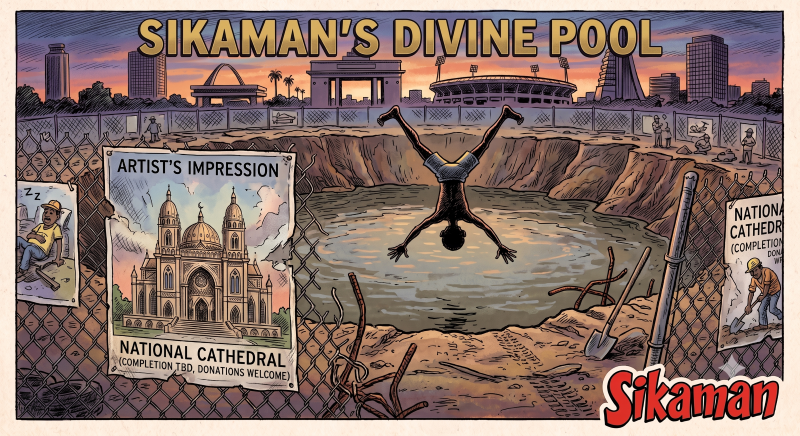
I know. You are thinking, “Kobina, people dig holes every day.” Yes, my brother. But this is not an ordinary hole. This is the most expensive hole on the African continent. This hole has cost the taxpayer ninety-seven million US dollars. And it has produced — after all that money, after all those years, after all the speeches and the sod-cuttings and the artist impressions — nothing. No walls. No roof. No pews. No altar. No Bible. Just a large, deep, weedy crater sitting in the middle of Accra, seven hundred metres from Parliament, where the Honourable Members can see it from their canteen window every lunchtime and chew their jollof in silence.
This, Kojo, is the National Cathedral.
You remember it, don’t you? You were still here when the promise was made. A certain gentleman in the big chair made a personal pledge to the Almighty. “Lord, if you give me the keys to the house, I shall build you a mighty building.” A personal pledge, Kojo. Between one man and his God. Beautiful. I have no problem with a man thanking God. I myself have promised God things at difficult moments — small things, a goat, a thanksgiving, an extra offering at church. But the difference, my brother, is that I promised my own goat. I did not promise God the nation’s goat and then send the bill to the taxpayer.
Because that is what happened, Kojo. The personal pledge was nationalised. The private promise became a public project. And before we could even say “Hallelujah,” the bulldozers arrived. Brand-new residential buildings — judges’ quarters, Kojo, where judges lived — flattened. The passport office — demolished. We displaced living, breathing, taxpaying human beings to make way for a building for the Almighty — who, last I checked the Good Book, does not live in temples built by human hands. Acts chapter 7, verse 48. Even the Bible is against this project, charley.
Then came the architect. A great man, Kojo. A world-famous Ghanaian-British architect. He drew a masterpiece on paper — pitched roofs, timber details, royal umbrella shapes. Beautiful. But the bill? Awurade. The man drew a small tent for Moses and charged us for the gates of heaven. Before a single block was laid, millions had already flown into consultants’ pockets. Auntie at the waakye stand cannot explain why her boiled egg has doubled in price, but the project found millions during the worst economic crisis in twenty years to pour into the soil.
And what did the soil produce, Kojo? Nothing. The soil ate the money and gave us back — a hole.
Now — eeeiii, Kojo, this is the part that made me put down my Milo — do you know what happened to the hole? The rains came. June arrived, the way June always arrives in Sikaman, with its water and its wahala. And the mighty crater — the ninety-seven-million-dollar national project — filled up with rainwater. And the boys from Tema, Kojo — the boys from Tema — came with their shorts, their towels, and their phones, and they swam in it.
Aboiii! They turned the National Cathedral into a swimming pool. A man named Sulley filmed himself diving in. The video went everywhere. The world’s most expensive swimming pool, charley — no changing room, no lifeguard, no lanes, just a crater full of God’s own rainwater and the dreams of a nation doing backstroke in it. Somebody suggested we fill it with water permanently and breed tilapia to pay off the national debt. Kojo, I laughed so hard my neighbour knocked on my wall.
There is a proverb the Ewe elders keep: “Ame ŋutɔ ŋutɔ wɔa eƒe nu.” — Each person does their own thing. Somebody certainly did their own thing with that ninety-seven million, Kojo. The auditors came — Deloitte and Touche, the big ones — and what they found would make an accountant weep and a pastor speak in tongues for real this time. Financial irregularities. Missing documents. Payments made before contracts were even signed. The board has been dissolved. The secretariat has been shut. And the nation is left holding a receipt for ninety-seven million dollars and a swimming pool for Sulley.
And the men of God, Kojo — ao, the men of God. You should have seen the Board of Trustees at the beginning. Front row, smiling, clerical collars freshly ironed, blessing the project with one hand and receiving the committee per diem with the other. But when the wahala started — when the financial rot began to leak and the public outrage boiled — the prophets suddenly received a new vision. And the vision said: run. One by one, they jumped off the cathedral ship like passengers fleeing a trotro whose brakes have failed on Aburi hill. You cannot blame them, Kojo. It is one thing to walk through the valley of the shadow of death. It is quite another to walk through a forensic audit.
Now — let me be honest with you, Kojo, because you are my friend and I do not want to lie to you the way the project lied to us. A cathedral is not a bad idea. I said it before and I say it again. Countries build great buildings. A nation needs landmarks. If somebody, with private money, had built a cathedral to God’s glory in Accra, I would have clapped. I would have attended the opening. I would have brought my auntie and her WhatsApp group and a plate of jollof. I do not mock the dream, Kojo. I mock the delivery. You do not promise your father-in-law a fat ram and then steal your neighbour’s goat to pay for it. And you do not promise God a cathedral and then hand Him a swimming pool.
What pains me most, my brother, is the small woman. The market woman who gave her widow’s mite — her honest five cedis — because the pastor said it was for God’s house. That five cedis is now at the bottom of the swimming pool, Kojo. It is somewhere between Sulley’s backstroke and the missing receipts. And she will never get it back. Her faith is still standing, but the building is not. And the men who collected her offering are not swimming in the crater. They are somewhere else entirely. Comfortable. Dry. Unaudited.
There is a Hausa proverb our northern brothers keep: “Komai nisan jifa, ƙasa zai faɗo.” — No matter how far you throw a stone, it shall fall to the ground. The stone of this cathedral has been thrown high, Kojo. Very high. But it is falling now. The audit is the ground. And when it lands — if it truly lands, if the people are brave enough to let it land — some of us may finally learn the oldest lesson in Sikaman politics: you cannot bribe the Creator with the public purse. God does not take bribes. That is what makes Him God and not a government official.
Kojo, I know you are reading this in your flat and shaking your head. I know you are thinking, “Charley, this country.” I know you are wondering, for the hundredth time, whether you made the right decision leaving. You did not, Kojo. And you did. Sikaman is impossible. Sikaman is home. Both things are true, and both of them hurt, and the swimming pool is the perfect symbol of both — a dream that was real, a promise that was broken, and a group of boys from Tema who looked at the wreckage and thought, “Well, since nobody is using it, we might as well swim.”
That, my brother, is the spirit of Sikaman. We do not wait for the building to be finished. We do not wait for the government to fix the hole. We bring our shorts and we make the best of what they left behind. It is not admirable, Kojo. It is not acceptable. But it is ours.
Now — what should we do with the hole? I have a small suggestion. Do not fill it. Leave it right where it is. Let every new government walk past it on their first day in office. Not to pray in it. Not to build in it. Just to look at it. And to remember that ninety-seven million dollars is buried there — along with judges’ houses, a passport office, the widow’s five cedis, and whatever is left of our trust.
Perhaps one day, Kojo, somebody will roof it and turn it into what it truly is: an underground museum of broken political promises. The entrance shall be free. The taxpayer has already paid.
Come home soon, my brother. But bring your swimming trunks. The cathedral is open.
Onyame mmoa yɛn, Sikaman. God help us. Because we tried to build Him a house, and we could not even manage the foundations. Yɛn ara asɛm. It is our own affair.
Yours from the edge of the pool,
Kobina Kokote
Lifetime swimmer in national disappointments · Honorary witness of sacred craters · Officially boycotting any pledge to God that arrives with a government invoice
P.S. — Kojo, one last thing. Sulley from Tema — the boy who swam in the cathedral — if you see this, my brother: you are a legend. You did with your body what the rest of us could only do with our mouths. You looked at ninety-seven million dollars of failure and said, “At least the water is free.” That, Kojo, is theology. We move.
You need a Sikaman Notes account to leave a response. Responses are reviewed before they appear.