
Sikaman Notes: The Man Who Loved Fufu to Death — A Love Story in One Mortar
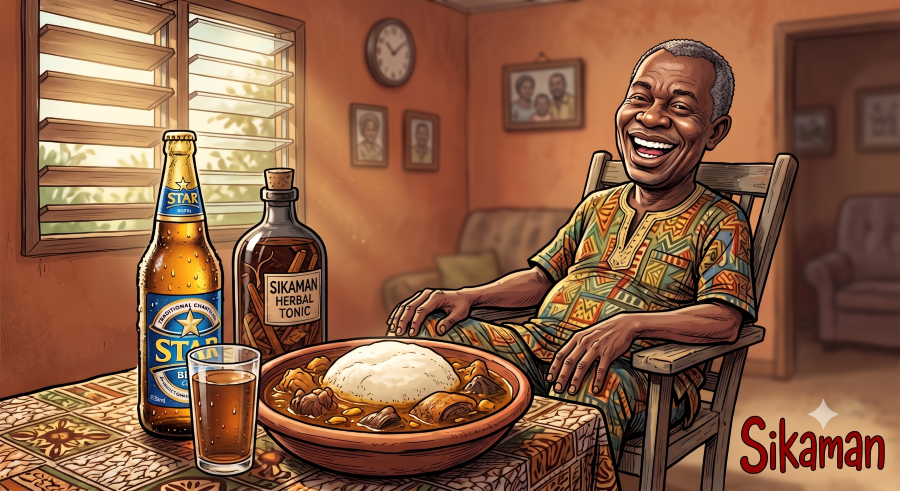
Sikaman, the world has its famous love stories. Romeo and Juliet. Samson and Delilah. The mosquito and your ear at 2am. But this morning, charley, I want to tell you about the greatest love affair in the history of this Republic — older than the flag, stronger than the cedi, and more faithful than any of the couples whose weddings we have attended.
The Ghanaian man and his fufu.
Let us begin with the facts, for the record, because our children abroad are growing up confused. Fufu is a Twi word, Sikaman. Ours. Born here, named here, pounded here first — before it travelled and the whole of West Africa started arguing about whose version is correct. (They are all wrong, charley. But let us be gracious. A man with the original does not fight over the photocopy.)
And how is this treasure made? Ei, my brother, it is not cooking. It is a ceremony. Boiled cassava and plantain enter the wooden mortar — the woduro — and then the pestle — the woma — begins its work. Rise. Strike. Rise. Strike. And between every single blow, Sikaman — between every falling of that heavy wood — a bare human hand enters the mortar, turns the fufu, and leaves. Enters. Turns. Leaves. Boom. Enters. Turns. Leaves. Boom.
Charley, I want you to appreciate what is happening there. That is not food preparation. That is a trust exercise that no marriage counsellor has ever dared to recommend. Two people — usually a mother and a daughter, or a wife and the husband she is still deciding about — performing a rhythm where one mistake means the family eats fufu with a small surprise inside. And yet, Sikaman, in the entire recorded history of this Republic, the hand has always escaped. Always. The pounding of fufu is proof, my brother, that when Ghanaians truly want to coordinate, we can. The evidence is in every kitchen. It has simply never been invited to Parliament.
Now — the eating. And here, Sikaman, we arrive at the law.
You do not chew fufu.
I need the foreigners reading this to sit down, because I know your whole body is fighting me. Yes, it is food. Yes, it is in your mouth. No, you will not chew it. You break a small piece with the right hand — only the right hand, charley; the left hand has other duties and everyone at the table knows what they are — you press a small valley into it, you scoop the soup, and then you swallow. Whole. Like a pill prescribed by your grandmother. The fufu is not there to be tasted, my brother. As one of our own chefs put it — and this should be printed on the currency — “Fufu is not meant to be tasted in the mouth. It is meant to be felt in the soul.”
The man who chews fufu in public, Sikaman, is telling the whole chop bar that he was raised by strangers. Heads will turn. An elder will look at him the way you look at a man wearing socks with chale wote. Somebody’s aunty will whisper, “Hwɛ, he is chewing it,” and the news will reach his hometown before he finishes the bowl.
And the soups, charley! Awurade, the soups. Because fufu never travels alone — fufu is royalty, and royalty moves with an escort. There is light soup, hot and honest, the one that clears your nose, your sins, and your sinuses in one sitting. There is groundnut soup, thick and sweet-tempered, the diplomat of soups, loved by children and grandmothers alike. There is abenkwan — palm nut soup — deep, red-gold, and serious, a soup with a full-time job. And there is ebunuebunu, the green one, the cocoyam-leaves soup that looks like the forest and heals like it too. The Yoruba cousins have a proverb that covers all of them: “Ọbẹ̀ tó dùn, owó ló pa á.” — The soup that is sweet, it is money that killed it. A proper fufu soup, Sikaman, can be heard from the road — the goat meat, the smoked fish, the snails sitting in it like chiefs at a durbar. When the soup is rich, the whole neighbourhood knows your salary has arrived.
Which brings me, Sikaman, to the man this piece is truly for. My own uncle. Wofa.
Every family has one fufu believer, charley, but Wofa is not a believer. Wofa is the cathedral. This man eats fufu in the morning. He eats fufu in the afternoon. He eats fufu in the evening, and — Sikaman, I swear it on the mortar itself — if you wake him gently at midnight and whisper that there is fufu in the kitchen, he will rise like Lazarus, wash his right hand, and report for duty.
Rain or sun — it does not matter. Harmattan or flooding season — irrelevant. Soft fufu, hard fufu, the medium one that cannot decide — Wofa receives all of them like a father receiving his children: equally, without favouritism. Even the fufu with lumps in it, charley — the one where the pounding finished early and small hills of unpounded cassava remain hiding inside like stowaways — even that one, Wofa eats with full joy. Other men complain about lumps. Wofa treats a lump the way a man treats a bonus: unexpected, but welcome. Smooth or lumpy, the man does not discriminate. His love has no conditions. I have seen marriages with more terms and conditions than Wofa’s relationship with fufu.
And the meat, Sikaman! Wofa’s fufu never sits in a lonely soup. There is always meat — goat today, smoked fish tomorrow, wele when the month is tired — and every soup in the rotation gets its turn: light soup Monday, groundnut midweek, abenkwan when God has been especially good.
But above all meats, Sikaman — above goat, above wele, above every fish in the sea — there sits one king on Wofa’s throne: akrantie. The grasscutter. And charley, what Wofa will do for akrantie, some men would not do for love. The man will enter his car — his own car, his own fuel, no complaints — and drive far. Past Nsawam. Past towns whose names I cannot remember. Because along those roads, the bushmeat sellers stand at the roadside holding the akrantie up high on sticks, presenting it to traffic like a trophy. And Wofa knows them all. But he does not buy from just anybody, Sikaman — tofiakwa. Wofa has his seller. One particular man, at one particular bend, and Wofa will drive past fifteen other sellers holding fifteen other grasscutters to reach his man — the way some people drive past fifteen churches to reach their own pastor. He parks. He comes down. He inspects that akrantie the way a customs officer inspects a suspicious suitcase — turning it, pressing it, looking at it from the side, asking questions the animal cannot answer. “This one — is it today’s own?” And only when he is satisfied, money changes hands.
Now, do the maths with me, charley. The akrantie: maybe eighty cedis. The fuel, there and back: more than the akrantie. Any economist would call this a loss. Wofa calls it an investment. Because when that man returns home with a grasscutter in the boot, Sikaman, the whole house changes. The children behave. The neighbours greet him twice. And the kitchen begins the great ceremony — because Wofa’s akrantie accepts only two escorts: the green soup, ebunuebunu, dark as the forest the animal came from — or a proper light soup, hot enough to make the grasscutter remember its sins. Akrantie with green soup and fufu, charley — when Wofa sits before that bowl, you can greet him, shake him, announce a fire in the compound — the man is not available. Government could fall. Wofa is eating akrantie. Priorities, Sikaman.
The man loves fufu, charley — loves it, present tense, ongoing, undefeated — and I use that word carefully, because most loves in this life come with conditions and his simply does not. Some men are known for their houses. Some for their business sense. Wofa is known for a standard — a way of sitting before a bowl with such complete happiness that the rest of us, watching him, understand, every single time, what the word contentment was invented for. Long may the mortar keep finding him.
And Sikaman, the beautiful madness of fufu is that even within our own borders, we cannot agree on it. The Ashanti and Akyem man wants his cassava mixed with plantain — and not just any plantain, charley, the big Apentu one, ask him, he will tell you. The Akwapim man looks at all that and says no, cocoyam only, and he is prepared to defend this at a family meeting. And the Krobo — ei, the Krobo, I salute you people — the Krobo will take fufu from yesterday, fufu that other tribes have already held a small funeral for, warm it inside palm-nut soup, call it fufu nkusa, and enjoy it like a man who has discovered free money. One nation, Sikaman. One dish. Four hundred opinions. That is how you know the love is real — nobody argues this passionately about something they do not care for. Ask any married couple.
Of course, the modern world has arrived, as it always does, holding a machine. There is now the fufu machine, charley — a blender with ambition — and abrokyire has gone even further: fufu powder, in a box, add hot water and stir, ready in four minutes. And look — I will not lie to you, Sikaman, I have eaten the powder one in a cold country and cried small, from gratitude and from grief at the same time. It fills the stomach. But it does not fill the house. Because real fufu was never only the food, my brother. It was the sound — that rhythm of wood on wood at dusk, the whole neighbourhood’s mortars answering each other like talking drums, telling every child within hearing distance: go home. Dinner is being built. No machine hums that message. No box of powder calls anybody home.
So here is my Kokote Suggestion, and today it is soft, like well-pounded fufu. Teach the children the mortar. Before the machine finishes taking over, let every Sikaman child pound at least once — let them feel the weight of the woma, let them learn the trust of the turning hand, let them hear the rhythm from the inside. The fufu machine can feed them, charley. Only the mortar can raise them.
Onyame nhyira wo, Sikaman — God bless you, the only nation on earth that swallows its dinner whole and still tastes it in the soul.
Yours, right hand washed and ready,
Kobina Kokote
Lifetime member of the no-chewing congregation · Honorary nephew of the cathedral himself · Officially boycotting any fufu machine that thinks it can replace the sound of dusk
P.S. — Wofa, one last thing, between us. I finally understand why you never answer anyone who greets you while you are eating. It is not rudeness. A man in the middle of fufu and akrantie is not available, because he has travelled somewhere better, and he will return when the bowl is empty. Long life to you, old champion — and next time you drive to your man at the bend for akrantie, save a seat in the car. I want to see this seller who has earned such loyalty. We move.
You need a Sikaman Notes account to leave a response. Responses are reviewed before they appear.