
Sikaman Notes: We Pay for the Light, We Receive the Dark
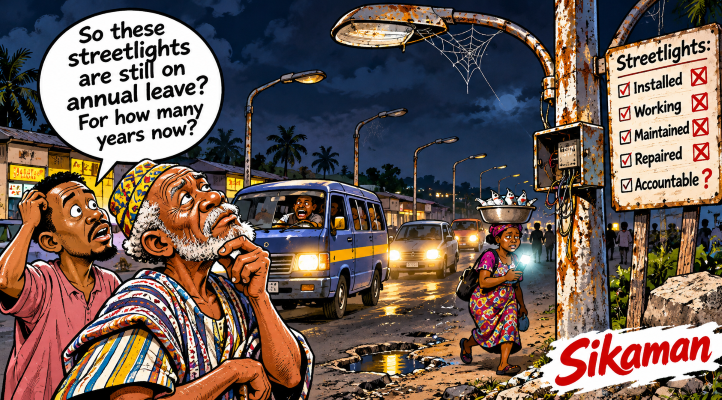
At about half past six every evening, Sikaman, the sun goes down over Accra, and the city performs a small magic trick.
It disappears.
Not completely. The shops still have their bulbs. The kelewele woman still has her lantern. The trotros still have one headlight each, sometimes. But the roads, charley, the roads go dark. Not dim. Not romantic. Dark. The kind of dark where you cannot tell whether that shape ahead is a pothole, a goat, a sleeping man or the edge of the world.
And standing along the side of those dark roads, every fifty metres, tall and proud and completely useless, are the streetlights.
Eeeii.
Let me describe a Sikaman streetlight, because foreigners need to understand what they are looking at.
It is a long grey pole. At the top, it bends forward like an old man looking at his feet. And at the end of the bend, there is a lamp.
The lamp does not light.
It has not lit for some years. Nobody remembers exactly when it stopped. Some say it was during the last election. Some say it was before the cedi was redenominated. An old woman near the junction swears it worked once, in 2009, for one whole week, and then went back to sleep like a soldier after a parade.
Some of the poles have no lamp at all. Just the pole, bending forward, looking down at nothing, like a man who has forgotten why he walked into a room.
Some have no cables either. The cables were cut and carried away at night by people who understand the value of copper far better than the authorities who installed it.
And some, charley, were knocked down by a truck years ago and are still lying in the grass where they fell, rusting peacefully, like a fallen warrior nobody came back to bury.
But here is the part that will make you laugh and then cry.
Every so often, Sikaman, you will find a streetlight that works.
And it is working at twelve noon.
Bright sunshine. Thirty-three degrees. Not a cloud in the sky. And there, on top of the pole, the streetlight is shining with all its strength, burning electricity into the daylight as if it is trying to help the sun.
You pass it again at night. Same pole. Same road. It is off.
Herh. We have streetlights that are afraid of the dark. They come out to play in the afternoon, when nobody needs them, and go home to sleep at sunset, exactly when they are wanted.
Now you might say, “Kokote, these things cost money. Maybe there is simply no money.”
Sit down, my brother.
Look at your electricity bill. Somewhere among the charges is something called the Public Lighting Levy. It is 3 percent of every unit of electricity you use. You pay it whether your street is lit or dark, whether your streetlight works at noon or never works at all. Over nine years, that levy is reported to have collected nearly GH¢1.8 billion.
And on top of that, since 2012, Ghana has borrowed and received in grants more than 32 million dollars specifically for street lighting.
So the money came from your bill. Then more came from loans. Then more came from a grant.
And the road is still dark.
Awurade. We are paying for the light. We are receiving the dark. And the dark, Sikaman, is free.
Let me show you how the story repeats.
In 2015, the authorities announced more than 1,200 new solar-powered streetlights along major highways. Beautiful. New technology. Light powered by our own generous sun.
Three years later, a parliamentary committee went to check and found that about 40 percent of the streetlights from the first phase were not working.
And the response? Another loan, for another phase.
That is the Sikaman method of lighting a country. Install the lights. Do not maintain them. Wait until they die. Borrow money for new ones. Repeat.
We are not building a lighting system, Sikaman. We are building a lighting graveyard, one loan at a time.
There was even a leaked report, attributed to the Auditor-General’s department, alleging that millions of cedis were once paid to contractors who did not exist, for streetlight work that also, apparently, did not exist. Ghost contractors fixing ghost lights. In the dark, of course, nobody could check.
So who is responsible for the streetlight outside your house?
Mtcheew. That is the funniest question in Sikaman, because everybody is responsible, so nobody is responsible.
Ask the Electricity Company, and they will tell you it is the assembly. Ask the assembly, and they will tell you it is the Electricity Company. Ask the Ministry of Roads, and they will ask whether it is a trunk road, an urban road or a feeder road. Ask Urban Roads, and they will send you back to the assembly. Ask the assembly again, and the man in charge has travelled.
Five offices. One dark pole. And the bulb at the top waiting patiently, like a patient being transferred from ward to ward while nobody actually treats it.
Now let me stop laughing, because the dark has a body count.
A parliamentary committee, explaining why Ghana needed yet another streetlight loan, wrote something every Ghanaian should know by heart:
“80% of the night-time fatal accidents occur on sections of the road without streetlights.”
Eighty percent, Sikaman.
The trotro driver who did not see the broken-down truck parked without warning triangles. The okada rider who did not see the pothole until his front wheel was inside it. The pedestrian in dark clothes who never saw the car, and the car that never saw him.
And ask any woman who walks home from the trotro station after work. She does not walk normally. She walks fast, phone torch on, bag pressed to her side, listening to every footstep behind her. Ask the residents whose neighbourhood robberies all seem to happen under the same broken streetlight.
Darkness is not just the absence of light, charley. In Sikaman, darkness is a co-worker for thieves and a silent partner in every night-time crash.
And the funny thing is, we know the difference light makes.
This year, the great interchange at Circle, the one we call “Circle Dubai,” finally lit up again after years of darkness. People drove through it at night and filmed it. They posted videos. They wrote “Ghana is rising!” with flag emojis.
Herh, Sikaman. A streetlight came back on, and we celebrated it like a national achievement.
In other countries, a working streetlight is not news. It is furniture. Nobody photographs it. It simply works every night, because somebody is paid to change the bulb and actually changes it.
Here, when the light finally returns, we film it, because we are not sure it will still be there next week.
There is an Akan proverb: “Sɛ kanea nni hɔ a, wo nan na ɛhwehwɛ kwan.” When there is no lamp, it is your feet that must search for the road.
And that is exactly how Sikaman walks at night. Feeling for the road with our feet. Driving with one eye on the tarmac and one eye on God. Holding up our phones like small torches, each of us lighting our own two metres, because the Republic, for all the levy we pay, has not lit the rest.
So here is my Kokote Suggestion, in four parts.
First, one owner. One agency per district, responsible for every streetlight, with its name and phone number painted on every pole. If the light is off, we know exactly whom to call.
Second, fix before you buy. No new streetlight loan until the old lights are working. We already have thousands of poles standing in the dark, waiting.
Third, show us the levy. Every quarter, publish how much the Public Lighting Levy collected, how much was spent, and on which streets.
Fourth, a timer and a padlock. Make the lights come on at night and go off in the morning, not the reverse. And lock up the cables properly, so the copper stays on the pole instead of travelling to a scrap yard.
Onyame mmoa yɛn, Sikaman. God help every driver, okada rider, pedestrian and every woman walking home with her phone torch tonight, on a dark road lined with poles we have already paid for.
Yours, walking home with my phone torch on,
Kobina Kokote
Lifetime payer of the 3% Public Lighting Levy · Honorary mourner at the streetlight graveyard · Officially boycotting any streetlight that shines at noon
P.S. Last week I finally found a streetlight on my road that was working at night. I stood under it for a full minute, just to feel what it was like. A small boy walking past stopped, looked up at the light, looked at me, and asked, “Uncle, is somebody important coming?” Chale, in Sikaman, even the children know that light only arrives with visitors. We move.
You need a Sikaman Notes account to leave a response. Responses are reviewed before they appear.