
Sikaman Notes: Go and Farm — Advice From People Who Have Never Held a Cutlass
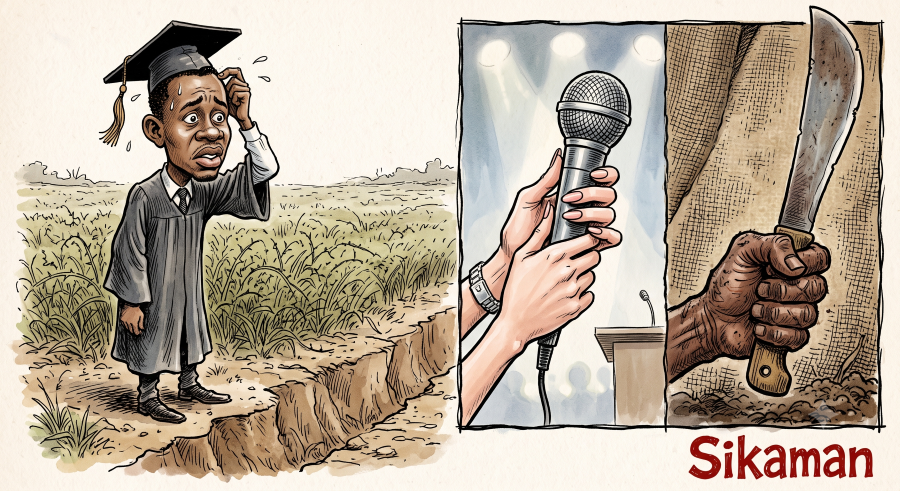
Sikaman, a big man spoke this month. A beloved veteran of our screens looked at the suffering youth of this country — the graduates with no jobs, the young people dreaming of Canada visas, the boys selling pure water at the traffic light — and he gave them his wisdom. “Don’t rush abroad,” he said. “Go and farm.”
Herh.
Go and farm. Charley, I want to be fair. There is truth inside that advice. This country has good soil. We import tomatoes from Burkina Faso and onions from Niger while our own land lies empty, and that is a national shame. So when a big man says “go and farm,” part of me wants to clap. The farm is honest. The farm is real.
But Sikaman, let me ask one small question, and I ask it with respect: when did the big man himself last hold a cutlass?
Because there is a Hausa proverb our northern brothers gave us, and it is the truest thing I shall write all year: “Mai cikin koshi ba ya jin yunwar mai yunwa.” — The one whose stomach is full does not feel the hunger of the hungry. And Sikaman, this is the great disease of advice in our country. The full-bellied are always advising the hungry to be patient. The man with three cars tells the man with no shoes to “work hard.” The pastor with the private jet tells the widow to “sow a seed.” And the comfortable veteran, resting in his well-earned home, tells the 24-year-old graduate sleeping in a kiosk to “go and farm.”
Mtcheew.
Go and farm where, charley? Let me follow this advice all the way to the ground, because that is where advice must be tested.
The young man hears “go and farm.” He is willing. Sikaman youth are not lazy — that is a lie the comfortable tell themselves to sleep at night. He says, “Yes, I shall farm.” So he goes to find land. The land belongs to a chief, who wants a fee he does not have. He finds a small plot at last. Now he needs seeds, he needs tools, he needs a cutlass, he needs fertiliser — which has tripled in price — he needs water, and he needs money to eat for the six months before the first harvest comes. He goes to the bank for a small loan. The bank looks at him — a young man, no collateral, no connection, no cousin inside — and the bank laughs the way only a Sikaman bank can laugh at a poor person’s dream.
Eeeii, Sikaman. Eeeii.
There is an Akan truth: “Aduane wɔ afuom.” — Food is in the farm. Yes. But charley, the farm is behind a gate, and the gate has a price, and the price has a cousin, and the cousin has a fee. You cannot tell a man to swim and then fill the river with crocodiles and then call him lazy when he stands at the bank, hesitating. Awurade.
Let me bring you young Fiifi. Fiifi has a diploma in accounting. A diploma, Sikaman. Three years of study, a graduation cloth his mother is still paying for. For two years he has applied to every bank, every office, every shop. Nothing. Last month, his uncle — a comfortable man with a government pension and a small belly — looked at Fiifi across the room and said the magic words: “My boy, stop wasting time. Go and farm.” Fiifi nodded politely, the way our culture demands. But later he told me quietly: “Kobina, my uncle has never farmed one day in his life. He has a garden boy. He has never broken the ground with his own hand. He says ‘go and farm’ the way other people say ‘good morning’ — it is a sound, not a plan.”
Ao. A sound, not a plan.
Saa, Sikaman. Saa.
So here is my Kokote Suggestion, my brother, and I give it to all the big men with the easy advice. If farming is the answer — and it may well be — then do not just shout it from your veranda. Boi, help build the road to it. Open the land. Make the chief’s fee fair. Make the bank lend to a young man’s sweat the way it lends to a politician’s signature. Subsidise the seed. Fix the price of the fertiliser. Make the farm reachable — and then, charley, you shall not need to tell the youth to go. They shall run. Sikaman young people have crossed deserts and oceans to find work. A people who will risk the Mediterranean Sea are not afraid of a cassava farm. They are afraid of pouring six months of their life into ground they do not own, for a harvest the market will buy at a robbery price.
Tofiakwa. The youth do not need a slogan, my brother. They need a gate that opens.
Onyame nhyira mmofra no, Sikaman. God bless the young ones. They are not running from work. They are running from a country that keeps telling them to walk while quietly removing the road.
Yours on behalf of the graduate in the kiosk,
Kobina Kokote
Lifetime holder of unused diplomas · Honorary listener to advice from the well-fed · Officially boycotting any man who says “go and farm” while his own hands are soft
P.S. — To the big men: my brothers, here is a small test before your next piece of advice. Look at your own palms. If they are smooth, soft, and have not met a cutlass since the Acheampong era, please lower your microphone small. The youth will take farming advice — but from a farmer, not from a man whose only crop has been opinions. We move.
You need a Sikaman Notes account to leave a response. Responses are reviewed before they appear.