Sikaman Notes: The Long Road From the Harbour — How One Car Becomes Two
Sikaman, my cousin Kweku has bought a car.
Eeeii, congratulations, I hear you say. Wait. Wait, charley. Let me finish before you start clapping. Kweku has bought a car in abrokyire. A nice, clean, second-hand Toyota. He paid for it. It is his. He has the papers. He has the key in his pocket. The car is fully his. And then Kweku, in his innocence, decided to do something that has ended the peace of mind of many a Sikaman man before him: he decided to ship it home.
My brother, let me walk you through what happened next, because Kweku is now a changed man. He has aged. There is grey in his beard that was not there in January. The harbour did that to him.
First, the shipping itself. The car must cross the sea. This part, charley, is the easy part — and even the easy part is not small money. To put the car on a big ship in Europe or America and float it gently to Tema takes a good sum — sometimes a thousand-and-something dollars or more — plus insurance, plus the small papers. Two to four weeks on the water. Kweku waited. He tracked the ship online like a man tracking a pregnancy. “It has reached Spain. It has reached the Canary Islands. It is near Senegal.” He was happy. He was a father waiting at the hospital.
And then the ship reached Tema. And that, Sikaman, is where the real journey began.
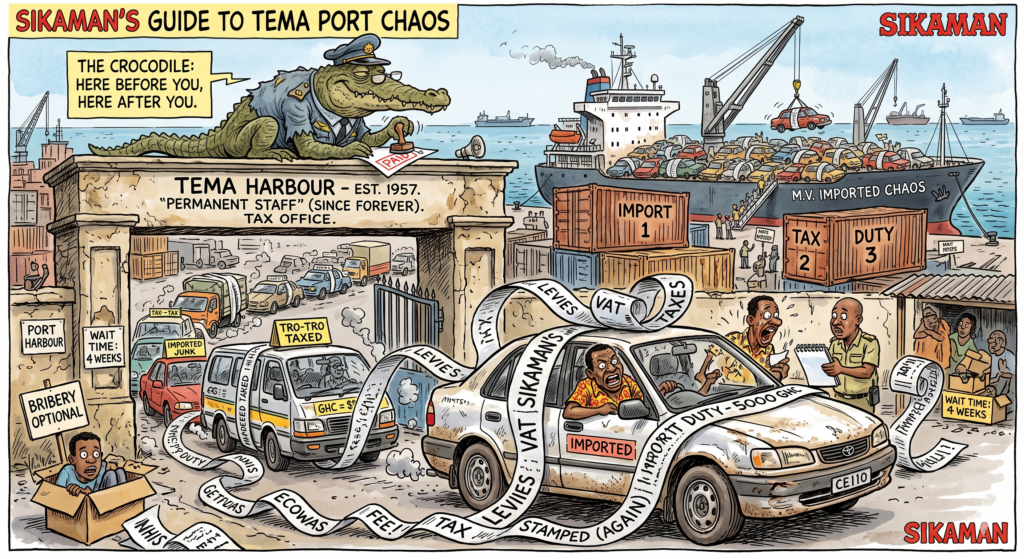
Because here is the thing nobody tells you, charley: the car crossing the ocean is the cheap part. The car crossing the last two kilometres — from the ship to the gate of the port — that is the expensive part. The Atlantic Ocean charges you less than the final gate at Tema. Eish. The sea is more reasonable than the harbour. The sea, at least, does not have an “examination fee.”
Kweku went to clear his car. To clear, Sikaman. We even have a special word for it. You do not “collect” your car. You do not “receive” your car. You clear it — the way you clear your name of a crime you did not commit. Because in the eyes of the port, my brother, your car is guilty until proven duty-paid.
And then the Tax Bill arrived. Awurade. Let me read to you what was on it, because it is a thing of beauty. It is poetry. It is a shopping list written by a system that has not missed a single opportunity:
Import Duty. (For the crime of importing.)
Import VAT. (For the crime of value being added.)
NHIL — for the nation’s health. (Your car is contributing to the national health insurance, even though your car has never been sick.)
GETFund — for education. (Your Toyota is now sponsoring a child through school. A child it will never meet.)
EXIM Levy — to support local trade. (By taxing the thing you imported. Think about it, charley.)
Examination Fee — they must look at the car. (Looking is not free. The eyes of the State cost money.)
Special Import Levy — extra, because the car is second-hand. (Yes, my brother. An additional tax specifically for the crime of buying a used car instead of a brand-new one you could never afford. They tax you for being poor enough to buy used.)
And the engine, Sikaman! They measure the cc of your engine the way a doctor measures blood pressure, and the bigger the engine, the higher the duty. Small engine, you pay small. Big engine — aboiii — you pay like a man who has insulted somebody important. The State has decided that a big engine is a sign of arrogance, and arrogance must be taxed.
By the time they finished adding, charley, the duty on Kweku’s car was almost the same price as the car itself. He bought one car in Europe. But by the time it touched Sikaman soil, he had effectively paid for two. One for himself, and one — invisible, untouchable, undriveable — for the Republic. Somewhere in a government account, there is a second Toyota made entirely of taxes. It has no wheels. It carries no passengers. But it exists, and Kweku paid for it.
Now — here is the part I want you to understand, Sikaman, because this is not new. This harbour has been eating cars long before Kweku was born. Kweku’s father shipped a car home in his own time, and he too aged at the gate of Tema. And his father before him. The harbour is older than all of us, charley, and its appetite has never once been cured — only managed, season by season, by whoever happens to be sitting in the big chair.
Watch the dance, my brother, because it has a rhythm. One season, they stand up in the budget and announce — with great joy — that they are reducing the duty. “We have heard your cry! We are giving you a discount at the port!” The traders clap. The car dealers clap. For a year, maybe two, the harbour loosens its belt and breathes. And then — quietly, charley, always quietly — another budget arrives, and the discount is reversed. In stages, so you do not notice. First the discount becomes smaller. Then smaller. Then one cold January morning, it is gone completely, and the duty is back to full, and the trader who clapped two years ago is now standing at the port wondering what he clapped for.
And the levies! Awurade, the levies come and go like visitors at a funeral. One season, a brand-new levy is added — a one-percent something, attached to everything you buy and everything you import, introduced for an emergency, a sickness, a hard time. “It is temporary,” they say. “It is only for the crisis.” And then the crisis passes — the sickness ends, the world recovers — and the levy stays. It keeps eating. One year. Two years. Three. Four. Collecting billions, long after the emergency that justified it has been forgotten, until a different chair decides, years later, to finally remove it — and holds a ceremony for the removal, as if removing a tax they themselves benefited from is a gift to the nation.
Do you see the dance, Sikaman? One adds, another removes. One discounts, another reverses. The faces in the chair change. The cloth changes. The party colours change. But the harbour — the harbour does not change. The harbour has watched governments come and go the way an old crocodile watches swimmers come and go: patiently, without emotion, knowing that sooner or later, everyone must cross the water, and the water belongs to him.
There is an Akan proverb the elders kept: “Aboa a ɔnni dua, Onyame na ɔpra ne ho.” — The animal without a tail, God brushes off its flies. But Kweku, charley, has a tail now — a Bill of Lading and a chassis number — and so God has stepped aside, and the harbour has stepped in to do the brushing. And it brushes thoroughly, my brother. It leaves nothing on the animal.
Now — let me be fair, because Kokote is a fair man. Some of this is normal. Every country taxes imports; a nation must collect revenue. And in fairness, charley, the present season has been kinder than some before it — a few of the duties came down, the cedi grew stronger, and the old emergency levy was finally taken away. I will give credit where it is due. The harbour’s belt is, this season, one notch looser. I am grateful. In Sikaman, we have learned to be grateful for the loosening of belts.
But here is the part that breaks Kweku, Sikaman — the part that breaks every importing Sikaman man, in every season, under every chair. It is not the amount. It is the theatre. The agent. The “facilitation.” The small envelope that makes the file move faster. The officer who looks at your perfectly correct documents and sighs, as if you have brought him a great problem, until something changes hands. The car that is ready on Monday but somehow only becomes “ready” on Thursday — and Thursday’s readiness has a price. We dey inside, charley. The official duty you can calculate on a website. The unofficial duty, only the gods of Tema know — and the gods of Tema do not change with the government. They are permanent staff.
There is a Ga proverb that fits: “Naa wo ye nu, naa wo ye gboi.” — The mouth that eats the food is the mouth that eats the trouble. At Tema, charley, many mouths must eat before your car can leave. The duty feeds the State. The “facilitation” feeds the man. The agent feeds himself. By the time everybody at the table has eaten, Kweku’s plate is empty, and the car he is finally driving home feels less like a blessing and more like a receipt with wheels.
So here is my small Kokote Suggestion. To Kweku, and to every Sikaman man dreaming of shipping a car home: calculate twice, charley. Use the official calculator. Then add the unofficial Tema tax — the envelope, the delay, the sigh. Then add it again, because you have underestimated it. Then decide. And to whoever sits in the chair, this season and the next: my brothers, by all means adjust the duty, add your levy, remove it, discount it, reverse it — that is your dance, and you will dance it long after I have stopped writing. But the theatre — the envelope, the Thursday-readiness, the permanent staff at the gate who serve no government but themselves — that is the one thing no budget speech has ever fixed. Fix that, and you will have done what none of your predecessors managed. Leave it, and the harbour will keep eating, no matter whose face is on the wall.
Onyame mmoa yɛn, Sikaman. God help us — a country where the ocean is cheaper than the harbour, where the levies come and go but the gate remains, and where the last two kilometres of a car’s journey cost more than the ten thousand kilometres before it.
Yours, still walking,
Kobina Kokote
Lifetime tracker of ships I do not own · Honorary payer of duty on a second invisible car · Officially boycotting any examination fee charged for the simple act of being looked at
P.S. — Kweku, my brother, I saw you driving the car on Sunday. It is beautiful. It is clean. It is yours — both of them, the real one and the tax one. Drive carefully. And when the next budget comes and they announce a new levy or remove an old one, do not get too excited or too angry either way. Your father stood where you are standing. So did his. The dance is older than the dancers. We move.
You need a Sikaman Notes account to leave a response. Responses are reviewed before they appear.