
Sikaman Notes: Funeral Jollof — The Last Meal of a Free Man
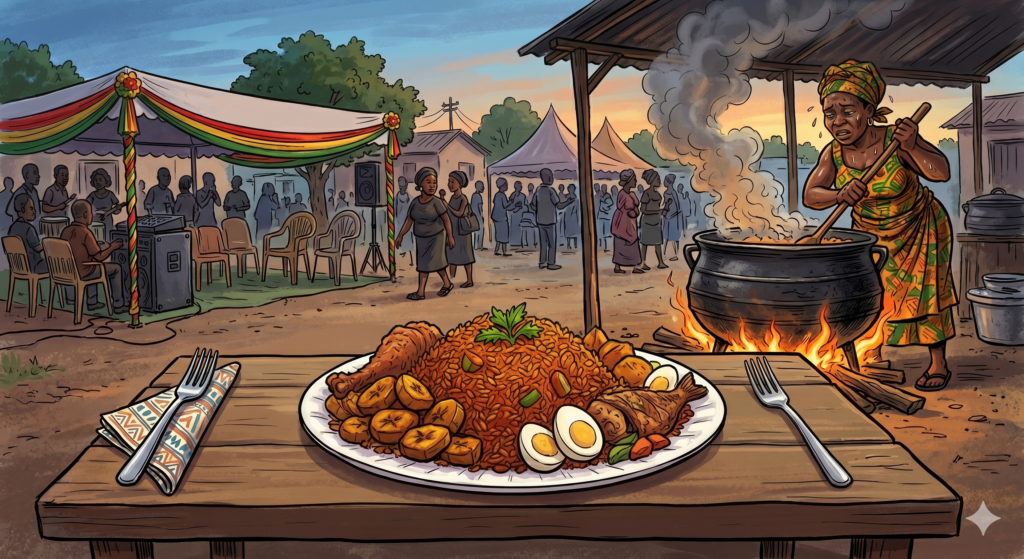
Sikaman, make I confess something to you this morning. I went to a funeral last Saturday. I did not know the deceased. I have never met any member of his family. I am not even sure which region he was from. But I went. Because at approximately 11:47am on a Friday morning, my cousin Adwoa called me and said the five words that have summoned Ghanaians for three generations:
“Charley, there be small program.”
That is all. Small program. In Sikaman, “small program” is not small. “Small program” means jollof for two hundred people, a DJ, six canopies, three brass band musicians, a man wearing kente who shall speak for forty-five minutes about a man you have never met, and one fridge full of Star Beer that has been chilling since Wednesday. “Small program” is what we call a funeral the way a doctor calls cancer “a little something.” It is a deliberate understatement, my brother, designed to lower your expectations so the reality can ambush you.
So I went. I arrived at 1:30pm. The “small program” was advertised to start at 10am. Eish. By Sikaman standards I was three and a half hours early. The deceased’s eldest brother had not even finished ironing his cloth. The DJ was still arguing with the canopy man about cable length. A small boy was running around with a roll of duct tape trying to fix a microphone that was already broken before the man died. Standard.
But I came for one reason, Sikaman, and let us not pretend otherwise: the jollof.
Charley, let me ask you a question, and I want you to answer honestly. Why does funeral jollof taste better than your mother’s jollof? Because we both know it does. Your mother is a wonderful woman. She raised you, she fed you, she paid your school fees, she beat you small-small when you deserved it. But Sikaman, between us, her Sunday jollof at home does not hit like that disposable bowl of jollof you receive under a stranger’s canopy at 2pm on a Saturday in Suhum.
Why?
I have studied this matter for many years, my brother. I have asked elders. I have interviewed catering aunties. I have even, Sikaman, forgive me, attended three different funerals in one Saturday for research purposes. (Yes. Three funerals, one day. The DJ at the third one greeted me by name — “Bro Kobina, you again?” — like I was a regular at a bar.) And after all my research, I arrived at a scientific conclusion:
Funeral jollof tastes better because it was cooked by a woman who has been awake since 3am, in an aluminium pot the size of a small canoe, over three blocks of firewood, by a person who is being paid per head and has zero patience for nonsense. That jollof is seasoned by suffering and supervised by ancestors. Even God Himself sometimes sneaks in for a small bowl.
But Sikaman — let me be honest, because a wise man does not tell only the sweet half of a story. Funeral jollof does not always taste the same. And here is the small secret nobody says out loud: you can read a dead man’s bank account from his jollof.
Eheh. You did not know? The plate is a bank statement, charley. One spoonful, and I can tell you to the nearest thousand cedis what the deceased was worth.
At the rich man’s funeral, the jollof is wearing a suit. It was cooked by a proper events company — one with a name, a logo, and a van. Gas burners, not firewood. Stainless steel, not the old black pot. Every grain of rice is behaving itself, served in a clean pack with a serviette folded beside it, and — Awurade — sometimes even a “continental table” in the corner for the been-to relatives, with small spring rolls that no real mourner has ever wanted. The jollof is perfect. Professional. Almost cold. It tastes like money that has been counted twice.
But at the poor man’s funeral, Sikaman — ao. That jollof was not cooked by a company. It was cooked by the dead man’s own sisters, his nieces, and the woman from the next house, in a borrowed canoe-sized pot, over three blocks of firewood, in the backyard, since 3am. And because they were crying while they stirred — because the same hand that wiped the eyes went straight back to the ladle — sometimes the fire was left too long. Sometimes the wood was wet and the smoke climbed into the rice. Sometimes the bottom went past crust and reached charcoal. So yes, my brother, the poor man’s jollof is sometimes dry. Sometimes smoky. Not always — but sometimes.
And yet — let me tell you the truth the spring rolls will never understand. That smoky jollof was cooked by people who actually loved him. The rich funeral hired strangers in branded aprons who will cook for a wedding tomorrow and a product launch on Friday and feel nothing in between. But the poor man’s sister cried into that pot. The smoke, Sikaman, is not a flaw. The smoke is the smell of love that could not afford a gas burner.
And there is one last law of the funeral pot, charley, and it does not care rich or poor. The good jollof — the moist top — is served first: to the chief mourners, the pastor, the DCE who came for ten minutes, the big men under the front canopy. By the time the spoon reaches the back — where the latecomers, the strangers, and the uninvited (this is me, Sikaman, I have already confessed) are seated — it is scraping the dry sides and the burnt bottom. The uninvited man eats the archaeology. And he cannot complain. Hungry man no dey choose. If you no buy cloth, you no fit talk. A man who came for free jollof does not get to write a food review.
Last Saturday I received a portion that was 70% rice, 20% smoke, and 10% genuine charcoal. I looked at it. I considered the long road I had travelled to bury a man I never met. And then I did what every Sikaman man does: I whispered to the man next to me, “Charley, this jollof is dry o” — and then I went back for a second helping. Both true. The criticism and the second helping. That, my brother, is the whole Ghanaian condition in one paper plate.
But Sikaman — somebody is paying for that jollof, dry or moist, smoky or sweet. And that somebody is usually a family that cannot afford to be paying for it.
Let us do small mathematics together. A modest Ghanaian funeral costs about US$5,000. A “befitting” one runs to US$15,000 or US$20,000 — roughly thirteen years’ salary spent in three days, to bury a man who, while he was alive, could not afford a second-hand fridge.
And this, charley, is the saddest part — some poor families borrow money they do not have, not for the casket, not for the cloth, but so that the jollof will not be smoky. So that no mourner can sit at the back, taste the plate, and read their poverty out loud. The shame of the smoky jollof has quietly put more families into debt than any bank in this country.
Let me describe the typical man. Call him Uncle Kwaku Wo-No-Wo-Akwantu — “Uncle Kwaku who came and went.” He lived in a chamber-and-hall in Madina. He worked security in Spintex for 1,800 cedis a month. His suit was the same one he wore to his wedding in 1994. He owned one cooler. One. Given to him by his late aunt in 2003.
Uncle Kwaku passed away quietly on a Tuesday. Without fanfare. Owuo atwedeɛ baako mforo — the ladder of death is not climbed by one person alone; it waits for every one of us. God called him home.
And then the family began to plan.
Suddenly the man who could not afford new slippers must be buried in a mahogany casket with brass handles at 18,000 cedis. Aunty Akos is suggesting a coffin shaped like a Toyota Vitz, “because he always wanted to drive one.” Sikaman. The man could not afford a Vitz alive. We are now buying him a Vitz-shaped wooden box at 25,000 cedis so he can ride to glory in the car he could not ride to work in. Eyaa.
Then the funeral cloth. Every cousin must buy six yards in the family colours. And Uncle Kwaku did not even like cloth. He wore the same brown trousers for fourteen years.
Then the billboard. Three thousand US dollars to advertise the death of a man whose own birthday was never advertised. The first time Uncle Kwaku has appeared on a billboard in his entire life is after he is dead. He has finally arrived. He has made it. Unfortunately, he cannot attend his own launch event.
Then the catering. Four big aluminium pots. Jollof, fried rice, banku-with-tilapia (because there is always banku-with-tilapia at a Ghanaian funeral; it is in the Constitution somewhere), light soup with goat meat, three fridges of Star Beer. Total: 22,000 cedis, minimum.
Then the brass band. Six men in white shirts who shall play “Onyame Adom” fourteen times because they only properly rehearsed one song. 4,500 cedis.
Then the MC — a man whose entire job is to announce things. He shall announce arrivals. He shall announce departures. He shall announce, four hours in, that “we shall now observe a moment of silence” — and the moment of silence shall last seven seconds before he resumes announcing. 3,000 cedis, plus food, plus drinks, plus a small envelope.
By the time Uncle Kwaku is in the ground, charley, his family has spent more on the funeral than Uncle Kwaku earned in his last five years of life combined. They have taken loans. The eldest son has dipped into his rent. Aunty Mansah has dissolved her susu. And the young niece in level 300 — the same niece with 6,000 cedis of outstanding school fees — has been quietly asked to contribute 2,000 cedis, “to honour Uncle Kwaku’s memory.”
Mtcheew. Sikaman, this thing is no longer for us.
And here is the part that truly breaks my heart, my brother. Two weeks after the funeral, when the canopies have folded and the relatives have flown back to Toronto, Uncle Kwaku’s widow is sitting alone in the same chamber-and-hall. Same fridge from 2003. Same broken fan. Only now, she has a loan repayment schedule. 800 cedis a month for three years. To repay the funeral — the funeral she did not even fully attend because she was crying too much to eat the jollof everybody was praising.
That, Sikaman, is the joke nobody is laughing at.
We bury our dead like kings. We forget our living like inconveniences. The same nephew who could not give Uncle Kwaku 50 cedis in February to fix his roof has now bought him an 18,000-cedi casket — and is posting the funeral photos on Instagram with the caption “Forever in our hearts ❤️🕊️” and tagging the casket maker. Tagging the casket maker, Sikaman. As if death is now content.
But let me not be too hard on us, my brother. I understand. When an African dies, his community wraps around him one last time. The funeral is the only event where the whole scattered family stands in one place — the cousin from Toronto, the aunty from Tema, the in-law from Hamburg who has not visited in eleven years. Death is the family reunion that birth was supposed to be. We make noise, we wear cloth, we feed two hundred people, because somewhere deep inside we believe that if the world sees how much we loved him, it will give us back a little of what it took. Even though it never does.
I understand, Sikaman. Funerals are how we say “we were here.”
So this morning, a small proposal — a Kokote Suggestion. Bury your dead with love, not with loans. Eat the funeral jollof with respect — even the smoky kind, even the charcoal bottom — but honour Uncle Kwaku by paying his niece’s school fees, not by buying him a Vitz-shaped coffin he cannot drive. And do not ever borrow money to hide your poverty behind a perfect pot of rice. The mourner who would judge a grieving family by their jollof is not a mourner — he is a man who should be eating at home. The ancestors do not check our bank statements. They check our hearts. And the dead do not eat jollof, dry or moist.
The living do.
Da yie, Uncle Kwaku. Sleep well, old man. We shall be paying for your funeral until 2029 — and we forgive you, because you did not ask for the Vitz coffin. That was Aunty Akos.
Yours with my mouth full,
Kobina Kokote
Lifetime funeral attendee (uninvited) · Voluntary jollof inspector · Officially boycotting any coffin shaped like a vehicle the deceased could not afford
P.S. — Aunty Mansah, I tasted the jollof on Saturday and I knew at once the family could not afford much. It was dry, the smoke had entered, the bottom was charcoal. But I want you to know — I went back twice. Not because it was sweet, but because it was honest. The rich funerals feed me perfect jollof cooked by strangers who feel nothing. Give me the smoky one, cooked by a crying sister, any day. Just — next time — guard the firewood small. We move.
You need a Sikaman Notes account to leave a response. Responses are reviewed before they appear.