
Sikaman Notes: The Pothole With a Government Name — Why Sikaman Roads Are Born to Die
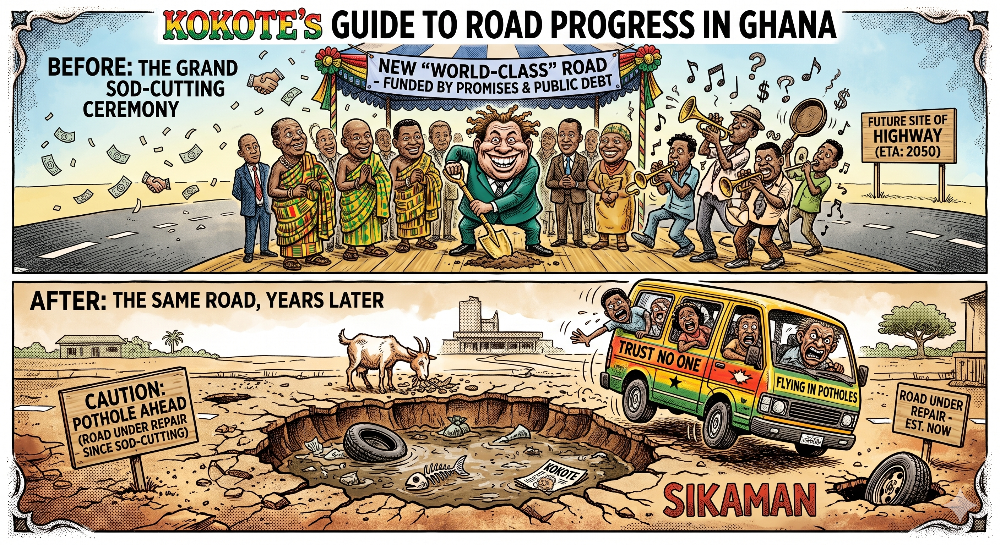
Sikaman, I want to introduce you to someone this morning. He lives on the Spintex road, about two hundred metres past the Shell station, on the left side, slightly before the small gutter that no longer works. He has been there for six years. He has survived three rainy seasons, two “rehabilitation” contracts, and one minister’s motorcade that swerved around him at high speed without slowing down. He has no birth certificate, but everybody knows his name.
He is a pothole, charley. And he is more permanent than most things in this Republic.
I am not talking about a small crack. I am not talking about a dip. I am talking about a crater — a hole so deep that when a taxi enters it, the passengers in the back seat briefly see God, and when it comes out the other side, the driver has aged three years and the shock absorber has filed for divorce. This pothole has been “patched” so many times that the patches now have their own potholes. It is a pothole with grandchildren.
And the worst part, Sikaman? Somebody was paid to prevent it. Somebody was paid to build the road. Somebody was paid to maintain the road. Somebody was paid to patch the pothole. And the pothole is still here, larger than before, as if it is feeding on the money we keep throwing into it.
Let me tell you how road construction works in this country, my brother, because it is a story funnier than anything I could invent.
Step one: The Sod-Cutting.
This is where Sikaman truly shines. We are the greatest sod-cutting nation on the face of the earth. Nobody — nobody, charley — cuts sod like a Ghanaian politician. The canopy is erected. The chairs are arranged. The brass band plays. The cameras flash. The minister arrives in a convoy that has already destroyed the very road they are about to “construct.” He lifts a golden shovel. He digs one ceremonial scoop of earth. The earth goes nowhere useful. The crowd claps. “The project has begun!”
Herh. It has not begun, Sikaman. The sod has been cut. That is all that has happened. The sod-cutting and the actual construction are two completely different events that sometimes — sometimes — happen in the same decade. On the Wa-Sawla-Bole road, heavy equipment was parked along the stretch for months after the groundbreaking ceremony. Just sitting there, charley. Beautiful machines, doing nothing, rusting quietly in the sun like a man who has been promised a job and is still waiting.
Step two: The Contractor Receives the Money.
This is the most important step, because after this step, anything can happen. The contractor receives his mobilisation funds — sometimes millions, sometimes tens of millions — and the nation exhales. “Finally, the road is coming.”
But Sikaman, let me read you something that was reported this year, because I need you to feel it properly. One contractor received approximately US$30 million in mobilisation funds for a road project. He did not start work. Another contractor received GH¢66 million for the Techiman–Wenchi road. Months later, all he had done was clear the grass.
Eeeiii. Sixty-six million cedis to clear grass, Sikaman. I have a cousin in Madina who will clear your whole compound for 50 cedis and a plate of waakye. He does not need mobilisation funds. He does not need a groundbreaking ceremony. He needs a cutlass and two hours. But the Techiman–Wenchi contractor needed sixty-six million and several months — and the road is still grass.
As the Igbo elders say: “Onye aghala nwanne ya.” — Let no one abandon his brother. But the contractor, charley — the contractor has abandoned the road, and the road was his brother. He took the bride price and left the bride at the altar. He has travelled.
Step three: The Accra-Kumasi Highway — A Two-Year Project That Took Thirteen.
Now, Sikaman, let me bring you the big one. The mother of all Sikaman road stories.
The Accra-Kumasi highway. Ghana’s spine. Two hundred and forty-five kilometres connecting our two largest cities, carrying more than 30 percent of the country’s trade. One road. And the story of what happened to just one small section of that road tells you everything you need to know about how we build in this country.
In 2008, the government awarded a contract to dualise the Kwafokrom-to-Apedwa stretch — 31.7 kilometres through Suhum. A straightforward job. The schedule said two years. By 2010, the road was supposed to be finished. Dual carriageway. Suhum Interchange. Footbridges. Done.
Charley. 2010 came. The road was not done. The government changed. The contractor slowed down. Then stopped. Then the equipment sat there — parked beside the unfinished road like a man who has fallen asleep at his own wedding. Years passed. The single lane kept carrying the whole country’s weight. People died. Trotros crashed. Traders lost goods. The road waited.
Then work resumed. Then stopped. Then resumed again. The south-bound carriageway opened. Then the interchange in 2020. Then, finally — finally, Sikaman — in December 2021, the Kwafokrom-Apedwa section was opened to traffic. Thirteen years after the contract was signed. A two-year project that took thirteen. A child who was born the year the contract was awarded was in JHS by the time the road opened. That child learned to read, write, do mathematics, enter secondary school, and begin preparing for his future — all in the time it took Sikaman to build 31.7 kilometres of road.
Now — to be fair, charley — the Suhum section is done. It is there. You can drive on it. The interchange works. Credit where credit is due. Somebody, after thirteen years and three governments, finally finished the job. Medaase.
But here is where the comedy starts again, my brother. The rest of the highway — beyond Apedwa, toward Kumasi — is still not dualised. Still single lane. Still the same road that kills. In January 2026 alone, a crash at Suhum Mankrong killed one person and injured thirty-seven. The bypasses at Osino, Anyinam, Enyiresi, and Konongo are still being built — or waiting to be built — or waiting for the contractor to come back from wherever he has travelled. The sections beyond the dualised part still have potholes so deep they resemble manholes, forcing drivers to swerve like men dodging their creditors at the market.
A trader on that road — a woman called Akosua Mensima, who has been using the highway for years — told a reporter something that should be carved into every minister’s desk: “The people in charge don’t experience what we go through.”
Ao, Sikaman. She is right. The people in charge fly. Or they travel in convoys with outriders who clear the road before them. The pothole does not exist for the minister. It only exists for Akosua.
And now — aboiii, now — here is the part that makes me want to laugh and weep at the same time. The government’s answer to all of this is not to finish dualising the rest of the highway. No, charley. The answer is to build a completely new road beside it.
A brand-new six-lane expressway. 198 kilometres. Accra to Kumasi. “We plan to commission it in 2028,” the Finance Minister said. Three years.
Herh! Sikaman, are you hearing this? It took us thirteen years to dualise 31.7 kilometres through Suhum. And now we are promising to build 198 kilometres of brand-new six-lane expressway in three years? Charley — 31.7 kilometres in thirteen years is roughly 2.4 kilometres per year. At that speed, the new expressway will be finished in the year 2109. My great-great-grandchildren shall cut the ribbon. I shall send them my golden shovel in my will.
There is an Akan proverb: “Obi nnim obiara asɛm.” — No one knows another person’s full story. But Sikaman, we know this road’s full story. We have been living it since 2008. The Suhum section is done — medaase, well done, we are grateful. But the road beyond it is still bleeding. And the promise of a new expressway — a bigger, shinier, six-lane promise — feels like a man who cannot finish painting one room of his house announcing that he is going to build a mansion next door. The paint is still wet, my brother. Finish the room first.
Step four: The Road is Built (Maybe) — Then Dies.
If — and this is a big “if,” Sikaman, the kind of “if” that carries its own insurance policy — if the contractor actually builds the road, a new problem appears. The road begins to die.
Not in ten years. Not in five. Within months. No sooner is a road constructed and commissioned than the potholes begin to emerge. The minister cuts the ribbon in January. By March, the first crack appears. By June — when the rains arrive — the crack has become a hole. By December, the hole has become a landmark. Trotro mates use it to give directions: “You will see a big pothole on your right — turn left there.” The pothole has become infrastructure, charley. It has replaced the road it destroyed.
And here is what the Roads Minister himself said — a real quote, Sikaman, not Kokote making jokes: “Some roads in Ghana fail within a year, not because contractors did poor work, but because vehicles are overloaded.”
Abah! The road fails within one year, and the explanation is “the cars are too heavy.” Charley, the Tema Motorway was built in the late 1950s. The 1950s. It is still standing — still serving as one of Ghana’s major transport corridors — after almost seventy years. Were the cars lighter in the 1950s? Were the lorries made of paper? Were the mammy wagons carrying feathers? The Tema Motorway has carried everything this country has thrown at it for seven decades, and the road we built last Tuesday cannot survive one rainy season. Something is wrong, and it is not the weight of the cars.
Step five: The Maintenance That Never Comes.
And here, Sikaman, is where the whole story breaks your heart.
In 2026, the government allocated GH¢30 billion for new road construction. In the same budget, it allocated GH¢3 billion for road maintenance — and that was GH¢100 million less than the year before.
Ao, Sikaman. Read that again. Thirty billion for new roads. Three billion for old roads. And the old roads got a hundred million less than last year. We are spending ten times more on giving birth to roads than on keeping them alive. We love the ribbon-cutting. We love the sod. We love the convoy and the golden shovel. But the road itself, once built, is an orphan. Nobody visits. Nobody feeds it. Nobody fixes the drain beside it. And when the rain comes and the road collapses, we do not blame the neglect — we blame the rain.
A policy group put it plainly: “Building new roads while the existing network deteriorates is not a transport strategy.” Mtcheew. It is not a strategy, Sikaman. It is a habit. The same habit that builds a hospital and never opens it. The same habit that launches a campaign and never follows up. We are a country of beginnings. The ending is always somebody else’s job.
There is an Akan proverb: “Obi nnim deɛ ɔbɛhyia ne ho bɛsi.” — No one knows what will happen to the thing they have neglected. Sikaman, we know. We know exactly what happens. It becomes a pothole. And then the pothole becomes a tourist attraction. And then the tourist attraction gets a contractor. And then the contractor gets his money. And then the contractor clears the grass. And then we are back at step two.
And do you know who finally fixes the road, charley? In Nyankrom, the frustrated drivers could not wait any longer. They organised their own communal exercise — they came with shovels and desilted the choked gutters themselves, disrupting traffic, because the alternative was to keep drowning. The citizens are now building their own roads, Sikaman. The same citizens who paid the fuel tax, the road toll (before it was removed), the income tax, the VAT — those citizens are now standing in the rain with shovels, doing the job their taxes were supposed to pay for.
There is a Hausa proverb from our northern brothers: “Sannu sannu shi ke kai wa rijiya.” — Slowly, slowly is what reaches the well. But Sikaman, our roads are not going slowly toward the well. Our roads are going slowly toward the grave. And the gravedigger is already paid in full.
So here is my Kokote Suggestion, and it is small. Stop building new roads until you can keep the old ones alive. One year. Just one year, charley. Take the golden shovel, put it down, and spend the money on the roads we already have. Patch every pothole. Fix every drain. Pay every honest contractor. Finish the Accra-Kumasi highway — finish it, my brother, after all these years, for the love of God and Akosua Mensima and every mother who has held her breath between Suhum and Apedwa. And at the end of that one year, if the Spintex pothole is still there — the one past the Shell station, the one that has been there for six years — then we shall know that the problem was never money. It was never the rain. It was never the weight of the cars. It was us.
Yɛn ara asɛm, Sikaman. It is our own affair. We build roads the way we build everything — with great ceremony, great spending, and zero intention of coming back to check.
Yours, still swerving,
Kobina Kokote
Lifetime resident of the left lane (avoiding the right) · Honorary navigator of craters · Officially boycotting any golden shovel that does not come with a maintenance budget
P.S. — To the pothole on the Spintex road, past the Shell station, on the left side: my brother, you have survived longer than three ministers and two contractors. You are now older than some of the cars that fall into you. If nobody will give you a name, I shall. From today, I am calling you “Honourable.” Because in Sikaman, anything that lasts that long in its position without being removed deserves a title. And to the Accra-Kumasi expressway they are promising to build in three years: my dear, at 2.4 kilometres per year, I shall see you in 2109. I have written it in my will. My great-great-grandchildren shall bring the golden shovel. We move.
You need a Sikaman Notes account to leave a response. Responses are reviewed before they appear.