Sikaman Notes: Please, Where Is My Please? — How One Word Runs the Whole Republic
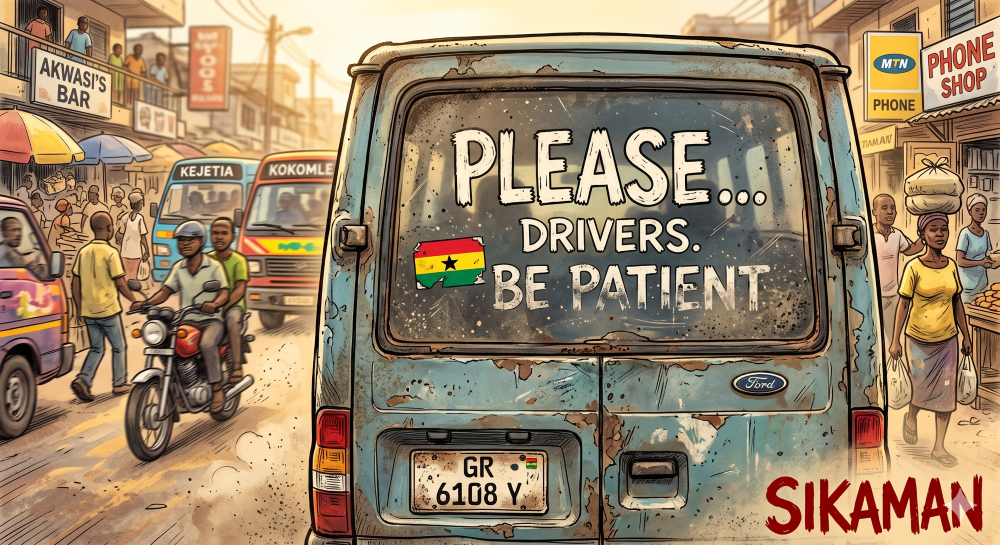
Sikaman, please, sit down.
I said please. Did you hear it? Good. Because in this country, my brother, “please” is not a word. It is a passport. It is a key. It is the one sound that opens every door, softens every blow, begins every sentence, ends every argument, and somehow — somehow, charley — manages to mean absolutely everything and absolutely nothing at the same time.
The English people invented the word. They use it to ask for tea. “Please may I have some tea?” One use. Clean. Simple. Done.
We took it. And we broke it. We broke it so beautifully that the English themselves cannot recognise their own child anymore. In Sikaman, “please” is not a request. It is punctuation. It is breathing. It is the national comma. A Ghanaian who removes “please” from his vocabulary will not be able to form a complete sentence. He will stand there with his mouth open, like a car without an engine, going nowhere.
Let me show you what I mean.
“Please, where is the market?” — a polite question. Fine. Normal. The English would understand this one. But now watch, charley. Watch what Sikaman does with the same word:
“Please, are you mad?” — this is not a polite question. This is a threat. The “please” at the front is not softening the blow. It is loading the gun. It is the calm before the slap. When a Ghanaian woman says “please, are you mad?” she is not asking about your mental health. She is informing you that your mental health is about to change. The “please” is the last kind thing you will hear before the wahala begins.
“Please, I am talking to you.” — this means you have been ignoring someone for too long and they have now reached the edge of their patience. The “please” here is a final warning. It is the smoke before the fire. In the military, this would be called “last chance before we open fire.” In Sikaman, it is called “please.”
“Please, who told you?” — this is not curiosity. This is investigation. The person does not want to know who told you. The person wants to know who told you so they can go and deal with that person next. The “please” is bait. It sounds friendly. It is not friendly.
“Please, I beg you, leave me alone.” — herh. This one has two pleases — the English one and the Twi one side by side. “Please, I beg you.” Mepa wo kyɛw. When a Ghanaian stacks “please” and “I beg” together, charley, it means the matter has reached a level where politeness is no longer a choice. It is a survival strategy. The person is not being polite. The person is exhausted. They have used up every other word in the language, and all that is left is please-I-beg, like the last two bullets in a gun that has been firing all day.
And then, Sikaman — and this is where the word truly earns its salary — there is the “please” of the con man.
“Please, I have sent you money by mistake.” You know this one, charley. The soft voice on the phone. The gentle “please” at the front of the sentence, laid down like a carpet before you are asked to walk into a trap. The scammer does not say “Give me your money.” He says “Please, my brother, I made a small mistake.” The “please” is the disguise. It is the uniform of honesty being worn by a thief. And it works, Sikaman — it works — because we have been trained since birth to respond to “please” the way a dog responds to its name. When we hear “please,” our defences go down. Our wallets open. Our suspicion sleeps. The whole national fraud industry runs on five letters and the goodwill of a people who cannot say no to a polite voice.
And then there is the “please” of the answer. The one that confuses every foreigner who has ever set foot in this country.
“Would you like some water?”
“Yes, please.”
Fine. Normal. But then:
“Are you going to the market?”
“No, please.”
No, please. Charley — please what? The foreigner hears “no, please” and waits. He thinks you are about to ask for something. He stands there, patient, expectant, and the Ghanaian walks away. The conversation is over. The “please” was not a request. It was a full stop. It was the period at the end of the sentence. The Ghanaian has said “no” and added “please” because saying “no” without “please” would be rude, and in Sikaman, we would rather confuse you than be rude to you. Politeness is more important than clarity. We will smile at you while you are lost, and the smile itself will get you more lost, and we will add “please” on top of the smile, and you will never find the market.
There is an Akan saying the elders kept: “Ɔkasa a ɛnni nyansa, ɛte sɛ ɛhyira a ɛnni tumi.” — Words without wisdom are like blessings without power. But Sikaman has performed a miracle, charley. We have taken one word — one small English word — and filled it with so much power that it can bless you, curse you, rob you, comfort you, threaten you, and dismiss you, all before lunch.
Let me give you the full dictionary, my brother. The Complete Ghanaian Translation of “Please”:
“Please, can you help me?” — I need something from you.
“Please, are you serious?” — You are not serious, and I am about to tell you why.
“Please, who sent you?” — Nobody sent you, and you should leave.
“Please, it’s okay.” — It is NOT okay, but I am tired of arguing.
“Please, don’t worry.” — Worry. Something has gone wrong.
“Please, I didn’t say anything.” — I said everything. I am now pretending I did not.
“Please, God forbid.” — Tofiakwa! with a polite wrapper.
“Please, let me land.” — I am not finished talking. Sit down.
“Please, my brother.” — I am about to ask you for money.
“Please, my sister.” — I am about to ask you for even more money.
“Please ehn, forget about it.” — Do NOT forget about it. I will bring it up again in three months during an argument about something completely different.
Eeeii, Sikaman. One word. Fourteen meanings. And not one of them is actually asking for permission.
Our Nigerian cousins, charley, they have “abeg” — which does the same job. “Abeg, leave me” does not mean he is begging. It means he is warning. “Abeg, how much?” does not mean he is kneeling. It means he is bargaining. Same energy, different seasoning. West Africa, my brother — we have taken the language of the people who colonised us and remade it in our own image. The British gave us “please.” We gave it a career.
And here is the part I love most, Sikaman. The hand. Because “please” in Ghana is not only spoken. It is performed. The back of one palm placed gently on top of the other, both hands together in front of the chest — that gesture is “please” without words. It is “mepa wo kyɛw” — “I beg you” — made visible. And when a Ghanaian gives you that hand gesture, charley, it is more powerful than any sentence. The gesture says: I respect you. I need you. I am not too proud to ask. A whole culture lives in that one movement of the hands.
There is a Yoruba proverb that says: “Ọ̀rọ̀ tó dùn ní ń mú ẹ̀fọ́n jáde nínú igbó.” — Sweet words draw the buffalo out of the forest. In Sikaman, the sweet word is always “please.” It draws money out of pockets, patience out of anger, forgiveness out of wives. It is the buffalo-caller of the Republic. And we use it so well, so often, and so shamelessly that the buffalo no longer even checks who is calling. It simply comes out of the forest, every time, and hopes for the best.
Onyame nhyira wo, Sikaman. God bless us — the only country in the world where “please” can start a prayer, close a deal, open a threat, and end a marriage, all before the rice is served.
Yours, please,
Kobina Kokote
Lifetime user of the national comma · Honorary speaker of fourteen meanings · Officially boycotting any sentence that does not begin or end with please
P.S. — To the foreigner who asked a Ghanaian “would you like some water?” and received the answer “No, please” and then stood there for five minutes waiting for the rest of the sentence: my friend, the sentence is finished. The “please” was the goodbye. Please go and sit down. Please
You need a Sikaman Notes account to leave a response. Responses are reviewed before they appear.