
Sikaman Notes: A Malaysian Tunnel vs a Choked Gutter
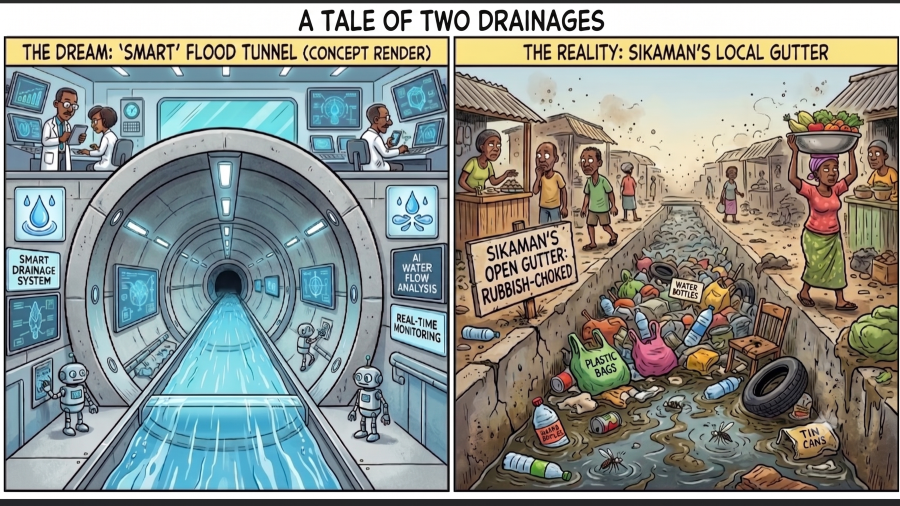
Sikaman, last week one of our serious newspapers carried a serious story with a serious headline. It said: “Ghana needs a SMART tunnel to solve flooding — Lessons from Kuala Lumpur for Accra’s future.” The story was long. It had photographs. It had numbers. It had quotes from people who have flown to Malaysia and come back with new ideas. We are now ready, the story said, to think big.
And charley, when I read it, I had to put my Milo down. Because the story is true. The tunnel is real. In Kuala Lumpur there is a tunnel almost ten kilometres long, wide enough to hold a double-decker motorway and a flood channel at the same time. When the rain is small, it carries cars. When the rain is heavy, the cars are pushed out, the gates close, and the same tunnel carries the river through the city until the storm passes. It cost about 515 million US dollars to build, and it has saved Kuala Lumpur from serious flooding since 2007.
Awurade!. It is a beautiful thing. Truly beautiful. I want one for Sikaman tomorrow. I want two. Let us put one under Circle and one under Kaneshie. Let us name the first one Kwame Nkrumah and the second one Yaa Asantewaa, so even the floodwater shall salute as it passes through.
But charley — and this is where I must sit down small and ask one question — who is going to clean it?
Because Sikaman, let us be honest with ourselves this morning. The same country that is now dreaming about a Malaysian super-tunnel is the country whose drains in front of Madina market have not been desilted properly since 2019. The same country. Same people. Same workers. Same cousin who got the desilting contract. We cannot clean a gutter that we can see with our own eyes, and we are now planning a tunnel that will live ten metres underground in the darkness. Charley, we dey inside.
Let me describe how it usually goes in Sikaman, so you understand why I am worried.
Day one: the project is announced. Big press conference. The minister wears his nicest cloth. There is a model of the tunnel on a small table, the kind a child could lift. Drones fly. Cameras flash. Somebody plays a video showing what Accra will look like after — green grass, dry roads, smiling children, a small white woman pushing a pram. The whole nation is happy. Finally, we say. Finally we are doing big things.
Day two: the budget is read. Aweeii. Maybe the small white woman shall have to walk; we cannot afford the pram. But the project must continue. Loans are taken. Bonds are issued. Three new committees are formed. One consultant flies in from Malaysia. He stays at Kempinski. He gives a talk about “phased implementation.”
Day three: the cousin appears. He always appears. There is no big Sikaman project without him. He is somebody’s cousin — sometimes the Minister, sometimes the DCE, sometimes a man we do not yet know but shall meet later in court. The cousin’s company gets a small piece of the contract. Sixty million cedis. For consultancy. What is the consultancy for? We do not know. The cousin himself does not know. But the cousin’s wife has just bought a Range Rover. Consultancy is sweet.
Day four: nothing.
Day five: nothing.
Day six: nothing.
Day seven: a small section of the tunnel begins to be built. Ten metres of pipe. It is laid in the wrong direction, but charley, progress is progress. The mistake shall be corrected at “phase two.”
By June of the next year, the rain comes. The tunnel is not finished. The Odaw River, which was supposed to be tamed by the tunnel, has been waiting patiently — and she has decided, in her ancestral way, not to wait again. The same families in Nima sleep on the same roofs. The same children are rescued by the same navy. The minister appears in the same rolled-up trousers. He says: “The tunnel will solve this. Phase two is coming.”
Phase two, Sikaman, is the favourite room in Sikaman government. Everything in Sikaman lives in phase two. The hospital is in phase two. The interchange is in phase two. The tunnel under Circle that was announced in 2026 shall be in phase two by 2034. There are babies born in this country whose entire lives shall be spent waiting for phase two. They will grow up, marry, have their own babies, and the second generation shall also be waiting for the same phase two. Saa.
Look — let me be fair to the tunnel idea. It is not a stupid idea. Big cities all over the world have built clever drainage, and there is nothing in Sikaman air that should stop us from doing the same. We have the engineers. We have the brains. We have a stock market that can raise 1.4 billion cedis in a month when Ghanaians believe in something. So the money and the talent are here. That is not the problem.
The problem is much smaller and much harder. It is maintenance. This country can build. We have proven it many times. What we have never proven — not once, not even by accident — is that we can take care of what we build. The streetlights work for one year then go dark. The traffic light at the junction has been blinking yellow since 2017. The library at the school has books, but the roof leaks and the books are now wet. The borehole was drilled with great ceremony in 2014; it has not given water since 2017. Officially, it is still a “water project.”
Charley, that is the truth nobody at the durbar wants to hear. We do not have a drainage problem. We have a maintenance problem. A tunnel that nobody cleans is just an expensive gutter ten metres in the air. The Malaysian tunnel works because Malaysians clean it — twice a year, with pressure washers, with engineers, with money, with seriousness. They reopen it in 48 hours. Forty-eight hours, Sikaman. In Accra, the broken streetlight in front of my house has been waiting for 48 months.
So here is my small Kokote Suggestion. Before we go to Kuala Lumpur for our next “study tour,” let us first try something small. Let us clean one gutter, properly, for one year. Just one. Pick any street in Accra. Send the real Zoomlion man, with a real shovel, every Saturday. No T-shirts, no cameras, no minister. Just one gutter, twelve months. If we can do that — if we, as a country, can simply maintain one open ditch for one calendar year — then we can talk about a tunnel. Then I shall personally drive the cousin’s Range Rover to Kuala Lumpur and back.
Until then, charley, the big dream is just a way to escape the small work. And the rain knows this. The rain has been watching us reach for Dubai for thirty years while the drain by Aunty Mansah’s market remained blocked. The rain has the patience of an elder. But every June, she sends us her small, polite reminder.
Onyame mmoa yɛn, Sikaman. God help us. Because we are a country that wants to fly before it has learned to sweep.
Yours dreaming small, building smaller,
Kobina Kokote
Lifetime resident of phase two · Honorary attendee of every model-unveiling ceremony · Officially boycotting all study tours to countries with working drainage
P.S. — To the consultant from Kuala Lumpur, if he reads this: my brother, please tell us the truth — how often do you clean your tunnel? Then please look us in the eye and ask whether we, as a people, are ready for that level of “every six months.” Be honest. Yɛbɛhyia bio. We shall meet again.
You need a Sikaman Notes account to leave a response. Responses are reviewed before they appear.