Sikaman Notes: The Party and the Poison — How Galamsey Saved Ghana and Killed It at the Same Time
Last year, Sikaman threw a party.
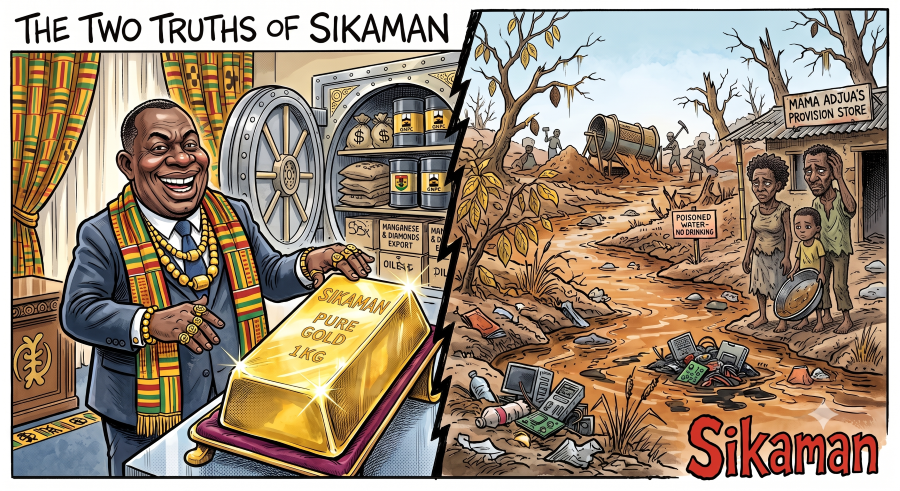
And charley, it was a proper party — not a small gathering under one canopy with borrowed chairs. A real one. The numbers came in from the Bank of Ghana and everybody stood up: gold exports hit twenty billion US dollars in one year. Twenty billion. Nearly double what it was the year before. The cedi — our long-suffering, much-mocked cedi — rose thirty-two percent against the dollar, climbing back like a man who fell into a gutter and somehow found his way out wearing a suit. The reserves filled up. The trade surplus grew fat. The whole economy breathed for the first time in years, and the people who manage these things smiled the smile of men who have passed an exam they were not sure they could pass.
Eeeii, Sikaman. We made it. The gold saved us.
But let me ask you one small question, charley — the kind of question you ask quietly, after the music stops and the guests have gone home and you are left alone with the empty bottles.
Which river is the gold from?
Because while we were counting the twenty billion, the Pra was dying. The Ankobra was choking. The Offin was running brown. The Birim, which your grandmother drank from with cupped hands, was carrying mercury and cyanide the way a trotro carries passengers — packed, going somewhere it was never meant to go. Water treatment plants in Tarkwa, in the Central Region, in the Western Region — shutting their gates, one by one, because the river arriving at their pipes was no longer water in any useful sense of the word. The turbidity reading — the science-man’s way of measuring how dirty the water is — hit fourteen thousand at some intake points. The plant is built to handle two thousand. Seven times over capacity. The plant looked at what was coming through the pipe and did the only honest thing left: it stopped.
So on one side of this story, Sikaman, is a number: twenty billion dollars. A record. A triumph. A party.
And on the other side is a glass of water you cannot drink from your own tap.
Both things happened in the same year. Both are true. And the gold that produced the twenty billion and the poison that is killing the rivers come from the same ground, turned by the same machines, in the same forests, along the same riverbeds. The party and the poison, charley, are the same event — just photographed from different angles. One angle shows the reserve figures and the rising cedi. The other shows a woman in Shama District carrying a bucket to a source she knows is not clean, because the clean one is gone, and the child needs water now and not after the next task force has been announced.
That is the whole problem with galamsey, my brother — and I want you to hear it plainly, because we have been talking about excavators and miners and rivers for years without saying the truest thing out loud:
We cannot kill galamsey, Sikaman. Because galamsey is now helping pay the national bill.
Look at the numbers with me. Small-scale mining — the kind done by hand, by machine, by young men in pits and rivers — accounts for roughly forty percent of all the gold Ghana produces. And of those small-scale operations, an estimated seventy to eighty percent are unlicensed. Illegal. Galamsey. And yet GoldBod — the new state body set up to buy and sell Ghana’s gold — exported billions of dollars of gold in its first year, much of it from small-scale sources. A Swiss organisation raised the alarm plainly: some of what is being counted as national export gold may have started its life in an illegal pit. A Ghanaian analyst wrote it even more plainly: a serious auditor “would very likely conclude” that the state’s gold-buying has been mixed with galamsey gold.
Nobody has published what percentage of the twenty billion came from legal ground. That number does not exist publicly, Sikaman. And the silence around it tells you everything — because if the number were clean, someone would have published it by now.
There is an Igbo proverb our cousins keep: “Onye wetara oji wetara ndụ.” — He who brings kola brings life. The gold, charley, has brought life to the economy — real life, measurable life, life you can see in the exchange rate and the reserve figures. Nobody is pretending it has not. But the same gold has brought something else to the rivers, to the farms, to the bodies of children born near the pits. And we have been celebrating the first thing so loudly that the second thing cannot get a word in at the party.
Let us talk about cocoa for a moment, because cocoa is the farmer’s side of this same story. Ghana has lost about nineteen thousand hectares of cocoa farms to mining directly — land dug up, poisoned at the roots, finished. In the Eastern Region at one point, more than eighty percent of cocoa farms had been touched by it. And the government, understanding what was happening, did something that tells you the scale of the problem: they raised the price they pay farmers for cocoa — not because the world price went up, but specifically to stop farmers abandoning their cocoa trees and walking into the nearest pit instead. The state was bidding, with public money, against the illegal mine — for its own farmers’ loyalty, on its own land.
Eight hundred thousand cocoa-farming families, Sikaman. Cocoa pays once a year, after the middleman has eaten. The pit pays tonight. That is the whole contest. And so far, the pit is winning.
And the health bill — ao, Sikaman — the health bill is the one that arrives last and stays longest. Mercury and cyanide in the soil and water do not announce themselves. They move quietly, into the groundwater, into the crops, into the fish, into the bodies of people who have no choice but to eat from the land and drink from the river. In Shama District, diarrheal cases doubled from five thousand to ten thousand in three years. Children in some mining communities are being born carrying the cost of a pit dug before they were old enough to know what gold is. And experts are warning — not as a distant possibility but as a current trajectory — that Ghana could be importing water by 2030. A country with the Volta, the Pra, the Ankobra, the Tano, buying water from outside, the way we already buy rice, the way we buy so many things we could grow and make ourselves, if only we had not destroyed the ground it grows from.
Herh. The ladder of death, charley, is not climbed by one person. Neither is this one.
Now — thirty years of fighting it, Sikaman. Since 1989. Laws in 2006. Task forces with action-movie names: Vanguard, Halt, Flush Out, Galamstop. Soldiers in forests. Excavators seized, burned, and then — as we have already established — somehow found back in the same forests the following month, mid-shift, working overtime. Seventy-six convictions in three years, while a million people mine daily.
And here is the political truth that nobody wants to say at the party: a million miners and four and a half million people who depend on them is a voting bloc. No government has ever truly killed galamsey, because no government that wanted to win the next election could afford to. The task forces run. The cameras roll. The arrests happen loudly. And then, quietly, the excavators walk home. Because the excavator owners — the financiers, the connected ones, the names that appear in reports and disappear from prosecutions — are not in the pit. They are at the party. They are holding the same gold we are toasting with.
One analyst put the sharpest sentence I have read on this whole subject: “Either the state cannot enforce its laws, or it will not.” Thirty years in, my brother, that is the only question left. And the answer, written in the colour of our rivers, is not ambiguous.
So here is my Kokote Suggestion today, and I give it not with anger but with the tiredness of a man who has watched the same party end the same way too many times.
Publish the number. The one number nobody will say: what percentage of the twenty billion came from licensed, legal, clean-ground gold? Put it in the GoldBod report. Let every citizen read it. And if the number is good — if it is clean — then say so proudly, and let the celebration be a full one. But if the number is not clean, Sikaman — if the gold in our reserve figures and the poison in our rivers come from the same shovel — then the party we threw last year was built on a floor that is eating itself from underneath. And the next party will be smaller. And the one after that smaller still. Until one day, my brother, there is no floor left — only the river, and the river by then will not be a river. It will be a record of everything we chose not to say.
Onyame mmoa yɛn, Sikaman. God help us — a country rich enough in gold to celebrate, and poor enough in courage to ask where the gold came from.
Yours, asking the question at the party,
Kobina Kokote
Lifetime drinker of boiled tap water · Honorary guest at celebrations built on silence · Officially boycotting any gold export figure that cannot say which river it crossed
P.S. — To whoever is in charge of the number that has never been published: my brother, the silence is itself an answer. And the river, which cannot speak, is giving the same answer in a different language — brown, slow, and getting worse every season. Publish the number. The water cannot wait for the next task force. We move.
You need a Sikaman Notes account to leave a response. Responses are reviewed before they appear.